

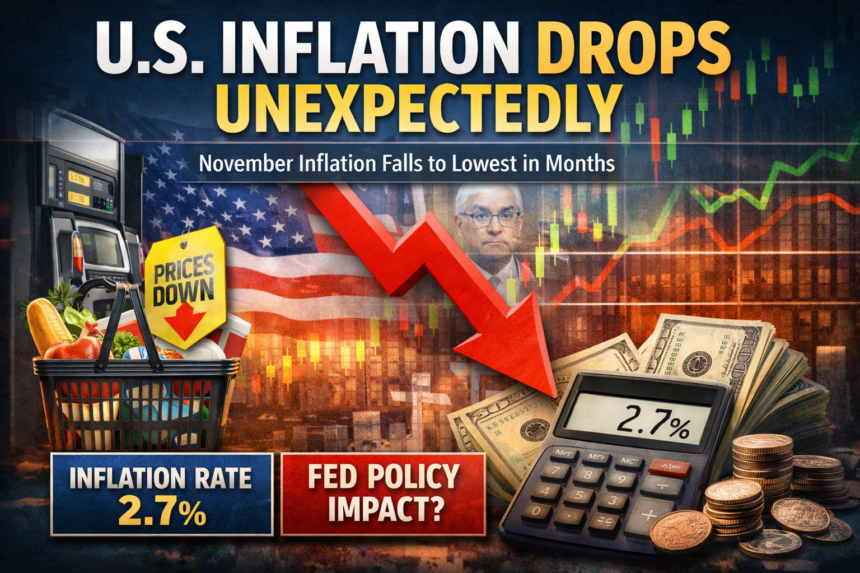
In a surprising turn of events, U.S. inflation slowed more than economists forecast in November 2025, with the Consumer Price Index (CPI) rising just 2.7% year-over-year — significantly below expectations of around 3.1% and down from a 3.0% increase in September.
This unexpected moderation in inflation — the lowest annual pace in several months — has triggered debate among economists, market analysts, policymakers, and everyday Americans about the health of the U.S. economy, the credibility of the data, and what lies ahead for interest rates, consumer spending, and broader economic growth.
Inflation measures how much prices for goods and services are rising over time. When inflation is high, the purchasing power of consumers’ money falls — meaning everyday items like groceries, gasoline, and housing become more expensive. Policymakers, especially the Federal Reserve, closely monitor inflation because it guides decisions on setting interest rates and shaping monetary policy.
The Federal Reserve’s long-term target inflation rate is 2%, a level that reflects stable prices without stagnation. At 2.7%, November’s inflation report still sits above that target, but the unexpected drop signals a potential easing of price pressures that could influence future policy decisions.
According to the Bureau of Labor Statistics (BLS):
-
Overall CPI increased by 2.7% year-over-year in November 2025, compared with the previous 12 months.
-
This pace was below the consensus estimate of about 3.1% among economists and a noticeable slowdown from the 3.0% recorded in September.
-
Core inflation, which excludes volatile food and energy prices, rose 2.6%, also lower than expectations.
These figures reflect the weakest inflation readings in several months, a development that initially boosted financial markets — with major indexes like the S&P 500 and Nasdaq posting gains following the release.
While the headline numbers suggest an encouraging trend, many economists and analysts caution against placing too much weight on the November inflation report, because it was heavily disrupted by a recent 43-day federal government shutdown.
The government shutdown — the longest in U.S. history — halted routine data collection by the BLS at the height of October and part of November. As a result:
-
Many price observations were estimated or imputed rather than directly collected.
-
The October CPI release was canceled entirely, leaving gaps in the usual month-to-month data.
-
Some prices, particularly in housing and rent, were held constant or filled with non-survey data, likely biasing the annual figures downward.
For these reasons, experts warn the report may understate actual price pressures, especially in categories like shelter that typically rise steadily. Early holiday discounts — including Black Friday sales — may also have skewed the data lower.
Leading voices in economics have offered mixed interpretations:
-
Some see the data as a potential first sign of inflation easing after recent years of elevated price growth. Others argue that the disrupted data collection renders the report unreliable, and future revisions could significantly alter the picture once normal surveys resume.
-
Several analysts believe that December’s CPI release, expected in January 2026, will provide a much clearer indication of true inflation trends.
For now, many economists urge caution, noting that apparent cooling may not reflect underlying economic realities. They emphasize that once complete data collection resumes, inflation could revert to higher levels than currently reported.
Financial markets reacted positively to the headline inflation data. Stocks rose across major U.S. indexes, signaling investor optimism that slower inflation could lessen pressure on corporate earnings and borrowing costs.
However, the implications for monetary policy are less clear:
-
The Federal Reserve has already cut interest rates three times in 2025 in response to slowing economic growth and rising unemployment.
-
Many economists believe the Fed may hold off on further rate cuts until more reliable inflation data is available.
-
If inflation continues to moderate without a sharp rise in unemployment, the Fed may consider more easing in 2026.
Despite the headline drop in inflation, many Americans report still struggling with high living costs, especially for essentials like food, health insurance, and utilities.
Even with a slower inflation rate, prices remain elevated compared to pre-pandemic levels, meaning households continue to feel pressure on budgets. Public sentiment reflects this strain, as recent polls and elections indicate that economic concerns remain at the forefront of voters’ minds.
The unexpected slowdown of U.S. inflation in November 2025 has generated both optimism and skepticism. While the headline numbers point to easing price pressures, significant data distortions due to a prolonged government shutdown complicate interpretation.
As policymakers, investors, and consumers await more complete data in the new year, the key takeaway is that the economy remains in a delicate balance — with inflation cooling, labor markets softening, and uncertainty high. The next CPI releases will likely be crucial in determining the pace of inflation and shaping monetary policy in 2026.