
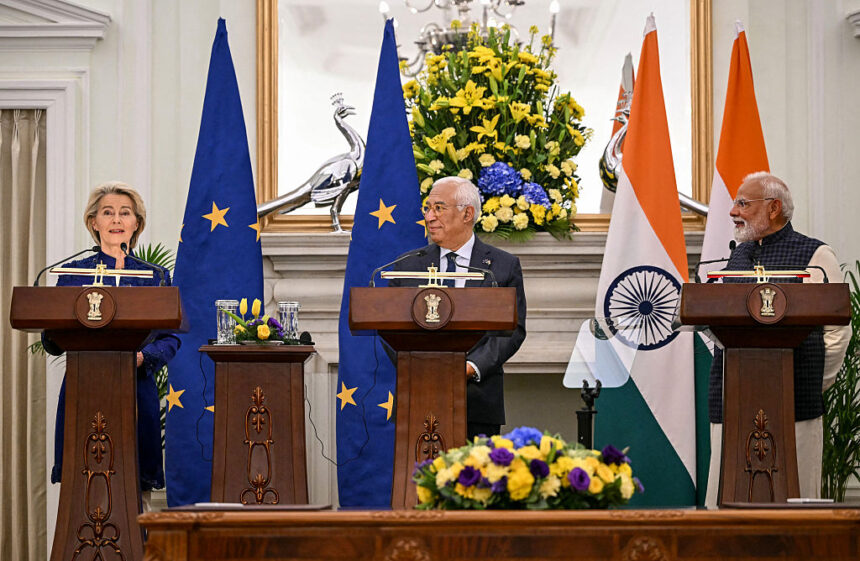
The long-anticipated trade agreement between India and the European Union (EU) has entered a crucial phase, signaling a potential breakthrough in one of the world’s most ambitious bilateral economic partnerships. With negotiations intensifying and both sides expressing renewed political commitment, the India–EU Free Trade Agreement (FTA) is now seen as a strategic move that could reshape global trade dynamics amid growing geopolitical and economic uncertainty.
Talks for the India–EU trade deal were first launched in 2007 but faced multiple setbacks due to differences over market access, tariffs, data protection, and regulatory standards. After years of stalled discussions, negotiations were officially relaunched in 2022, driven by changing global supply chains, post-pandemic economic recovery needs, and a shared interest in reducing dependency on single markets.
Since then, several negotiation rounds have taken place, focusing on trade in goods and services, investment protection, intellectual property rights, digital trade, and sustainable development. Recent reports suggest that both sides are now closer than ever to bridging long-standing gaps.
The European Union is India’s largest trading partner, while India is one of the EU’s fastest-growing major economies. Bilateral trade in goods and services is valued at over €120 billion annually, with strong potential for expansion.
For India, the deal offers:
-
Improved access to European markets for textiles, pharmaceuticals, IT services, and agricultural products
-
Increased foreign direct investment (FDI) from EU companies
-
Integration into global value chains, especially in manufacturing and green technologies
For the EU, the agreement provides:
-
Access to one of the world’s largest consumer markets
-
Opportunities for European firms in infrastructure, renewable energy, finance, and digital services
-
A strategic partnership with a key Indo-Pacific economy
One of the most sensitive aspects of the negotiations involves tariffs. The EU is pushing for lower duties on automobiles, wines, spirits, and luxury goods, while India seeks better terms for labor-intensive exports such as garments, footwear, and processed food.
India aims to secure easier mobility for skilled professionals and greater recognition of qualifications. Meanwhile, the EU is emphasizing data protection, cross-border digital trade rules, and cybersecurity standards.
A major feature of the proposed agreement is a strong sustainability chapter. The EU wants binding commitments on labor rights, environmental protection, and climate goals, aligning with its Green Deal objectives. India has expressed willingness to cooperate while safeguarding its development priorities.
Negotiations are also underway on a separate investment protection agreement to ensure legal certainty for investors on both sides, a key demand from European businesses.
Beyond economics, the India–EU trade deal carries major geopolitical weight. As global trade faces disruptions due to conflicts, protectionism, and supply-chain realignments, both India and the EU see this partnership as a way to promote rules-based trade and economic resilience.
For India, closer ties with the EU complement its broader strategy of strengthening partnerships with major global blocs while maintaining strategic autonomy. For the EU, deeper engagement with India supports its Indo-Pacific strategy and diversifies its economic relationships away from over-reliance on a few markets.
Despite progress, several hurdles still need resolution. Differences over agricultural subsidies, carbon border taxes, intellectual property rules, and regulatory alignment continue to pose challenges. Experts caution that while political intent is strong, translating it into a balanced and mutually beneficial agreement will require careful compromise.
Domestic stakeholders on both sides—including farmers, industry groups, and civil society organizations—are closely watching the negotiations, urging their governments to protect local interests.
Officials indicate that the goal is to conclude negotiations in phases, starting with areas of early consensus. If successful, the India–EU trade deal could become one of the most comprehensive agreements either side has signed, covering trade, investment, sustainability, and digital cooperation.
As talks continue, businesses and investors are optimistic that the agreement will unlock new opportunities, boost job creation, and strengthen economic ties between two major global players.
The India–EU trade deal represents more than just a commercial agreement—it reflects a shared vision for cooperation in a rapidly changing world. While challenges remain, the renewed momentum suggests that both sides recognize the strategic value of partnership. If finalized, the agreement could mark a historic milestone in India–EU relations and set a new benchmark for future global trade agreements.