
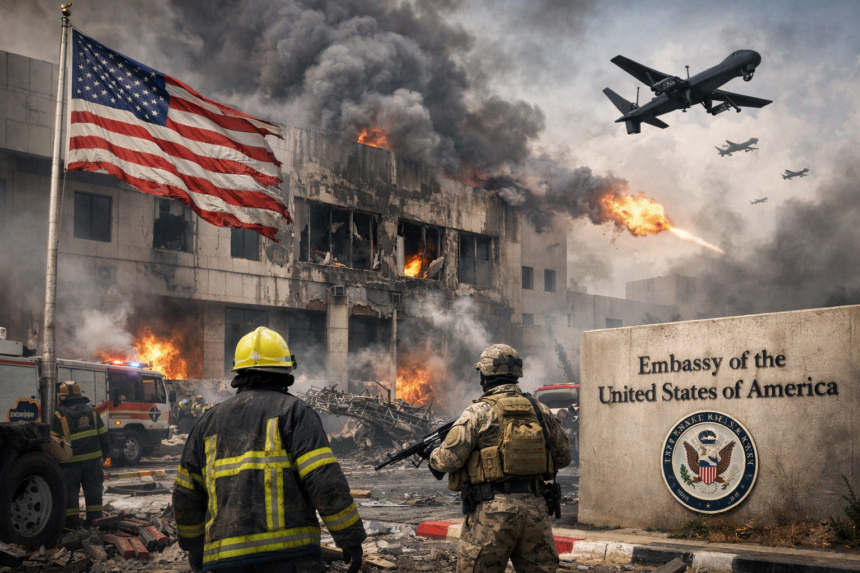
In a dramatic escalation of the Middle East conflict, two Iranian drones struck the United States Embassy in Riyadh, Saudi Arabia on Tuesday morning, causing a limited fire and minor material damage to the diplomatic compound, according to Saudi authorities. The attack — one of the most significant direct assaults on a US diplomatic mission in the Gulf in decades — has triggered stern warnings from Washington and raised the specter of further retaliation as regional hostilities continue to spiral.
The drone strike occurred early on March 3, 2026, targeting the embassy located in the Diplomatic Quarter of Saudi Arabia’s capital city. Saudi Arabia’s Ministry of Defense confirmed that two unmanned aerial vehicles (UAVs) struck the embassy compound, igniting a small fire that was quickly contained and extinguished by local emergency services.
Witnesses reported hearing a loud explosion and seeing plumes of black smoke rising over the area shortly after the attack. According to sources familiar with the situation, the embassy was unoccupied at the time, and no casualties have been reported.
In addition to the two drones that made contact, Saudi air defenses reportedly intercepted four other UAVs aimed at the diplomatic quarter, suggesting a coordinated assault rather than an isolated incident.
Following the attack, the US Embassy in Riyadh urged American citizens in the region to “shelter in place” and avoid the vicinity of the compound until further notice. The advisory extended to other cities including Jeddah and Dhahran, reflecting heightened concerns about additional threats.
Operations at the embassy were suspended temporarily, with all routine services cancelled as officials reassessed security measures. Foreign governments with missions in the Diplomatic Quarter are also reported to have reviewed their own protective protocols in light of the drone strike.
While Tehran has not publicly claimed responsibility for the Riyadh attack, regional analysts and international media widely attribute it to Iranian forces or Iran-aligned proxies as part of a broader campaign of retaliation. The strike comes amid an intensifying war between Iran and a coalition including the United States and Israel, which began after joint airstrikes targeted Iranian military infrastructure earlier last week.
In recent days, Iran has launched numerous missiles and drones targeting US bases and allied facilities across the Gulf region, including in Kuwait, Bahrain, and now Saudi Arabia. These assaults have disrupted travel, strained energy markets, and inflamed geopolitical fault lines extending from the Persian Gulf to the Mediterranean.
In Washington D.C., US President Donald Trump vowed a response to the embassy attack, though he stopped short of detailing specific actions. Speaking to NewsNation, Trump warned, “You’ll find out soon what the retaliation will be”, emphasizing that the United States would hold responsible parties accountable for the strike.
When pressed on whether American forces might be deployed on the ground in Iran or elsewhere, the president indicated that such a step was unlikely, underscoring instead the US military’s capability to respond with a range of measures short of a full-scale ground invasion.
The US has also reportedly been in consultation with Saudi leaders and other Gulf allies about coordinated responses and enhanced defensive measures to protect diplomatic installations and military bases in the region.
The incident has drawn responses from across the international community. Saudi Arabia condemned the attack as an act of aggression against a sovereign host nation and international diplomatic mission, highlighting the risks posed to regional stability. Other Gulf states hosting US assets are reassessing their own security postures amid rising threats.
The incident has also reignited debate in global capitals about the trajectory of the Middle East conflict. Nations with interests in the Gulf — including members of the European Union, Russia, China, and India — are calling for restraint and urgent diplomatic engagement to prevent further escalation.
Energy markets reacted swiftly: crude oil prices surged after the report of the embassy hit, as traders factored in the potential for broader disruptions to supplies and transportation routes in a region that handles a significant portion of the world’s oil exports.
As investigations continue and diplomatic channels remain active, the world watches closely how Washington and its partners will respond. The attack on the US Embassy in Riyadh represents a stark reminder of how far the conflict has escalated — and how quickly diplomatic norms can be threatened amid broader warfare.