

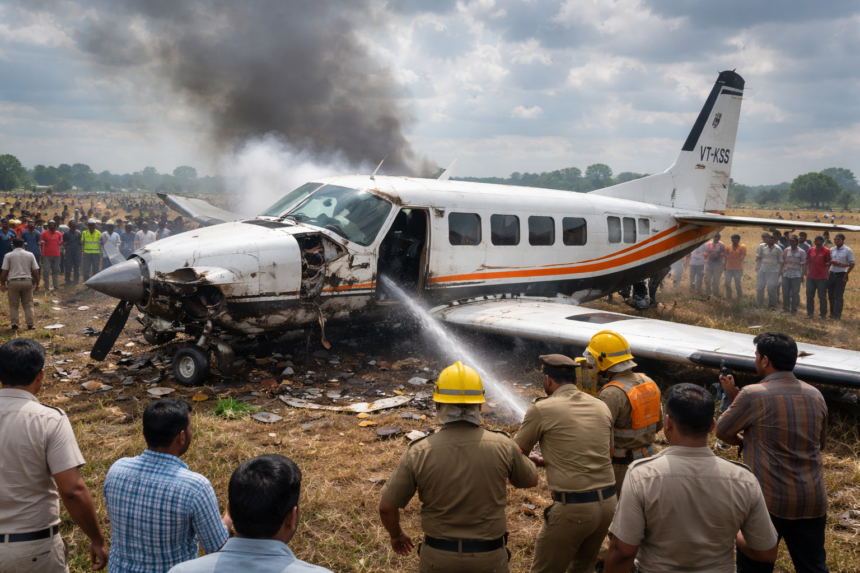
Rourkela, a major industrial city in Odisha, witnessed moments of fear and confusion when a small passenger aircraft made an emergency crash-landing in an open area near the city. The incident occurred during a routine domestic flight and immediately drew the attention of local residents, emergency services, and aviation authorities. While the visuals of the damaged aircraft raised serious concerns, the incident ended without any loss of life, offering a sense of relief amid the shock.
What Happened
The aircraft, a small nine-seater plane operating a regional route, was en route from Bhubaneswar to Rourkela. As the flight neared its destination, the crew reportedly detected a technical malfunction. Sensing potential danger and prioritizing passenger safety, the pilots informed air traffic control and decided to perform an emergency landing instead of attempting to reach the airport runway.
Within minutes, the aircraft descended rapidly and touched down in an open field located a few kilometers away from Rourkela airport. Due to the uneven terrain, the aircraft sustained visible damage to its landing gear and body. However, the controlled manner in which the pilots handled the situation prevented a major disaster.
Passengers and Crew Safe
There were six people on board the aircraft, including pilots and passengers. Despite the intensity of the landing, all occupants survived the incident. Some individuals suffered minor to moderate injuries such as bruises and fractures and were immediately taken to nearby hospitals for treatment. Medical officials later confirmed that none of the injuries were life-threatening and all passengers were out of danger.
Doctors praised the quick response of emergency teams and local residents who rushed to the spot after witnessing the landing. Their timely assistance helped transport the injured to hospitals without delay.
Local Response and Rescue Efforts
Residents living near the crash site described hearing a loud noise followed by the sight of the aircraft descending unusually low. Many feared the worst and rushed toward the site to help. Police, fire services, and ambulances reached the area promptly and secured the surroundings to prevent further risks.
Authorities cordoned off the site to allow aviation experts to assess the aircraft. Firefighters ensured that there was no fuel leakage or risk of explosion. The coordinated rescue operation was widely appreciated for preventing chaos and ensuring passenger safety.
Government and Official Statements
Soon after the incident, senior state officials were informed, and the Odisha government expressed relief that no lives were lost. Authorities assured full medical support to the injured and emphasized that passenger safety remains a top priority.
The Directorate General of Civil Aviation (DGCA) ordered a detailed investigation into the incident. Officials stated that the aircraft would undergo technical examination to determine the exact cause of the malfunction. Initial observations suggest a mechanical issue, but the final report will be released after a thorough review.
Importance of Pilot Skill and Training
Aviation experts have highlighted that the successful emergency landing was largely due to the pilots’ presence of mind and training. Handling an aircraft malfunction at low altitude is one of the most challenging situations for pilots, and their ability to make quick decisions played a critical role in avoiding casualties.
Experts also pointed out that emergency landings, though rare, test the preparedness of both flight crews and ground authorities. In this case, effective coordination between pilots, air traffic control, and emergency responders ensured a safe outcome.
Concerns Over Regional Air Safety
The incident has once again brought attention to the importance of strict safety checks for regional aircraft. With increased focus on connecting smaller cities through regional air services, ensuring aircraft maintenance and operational reliability has become more crucial than ever.
Passengers and aviation analysts have urged authorities to strengthen inspections, especially for small aircraft operating frequent short-distance flights. While air travel remains one of the safest modes of transport, even minor technical lapses can pose serious risks.
A Close Call, A Valuable Lesson
The Rourkela aircraft crash-landing serves as a reminder of how quickly routine travel can turn into an emergency. At the same time, it stands as an example of how skill, training, and preparedness can prevent tragedy.
As investigations continue, authorities are expected to implement any necessary safety recommendations. For now, the incident ends as a close call—one that highlights the resilience of passengers, the professionalism of pilots, and the importance of strong emergency response systems.