



Mumbai:
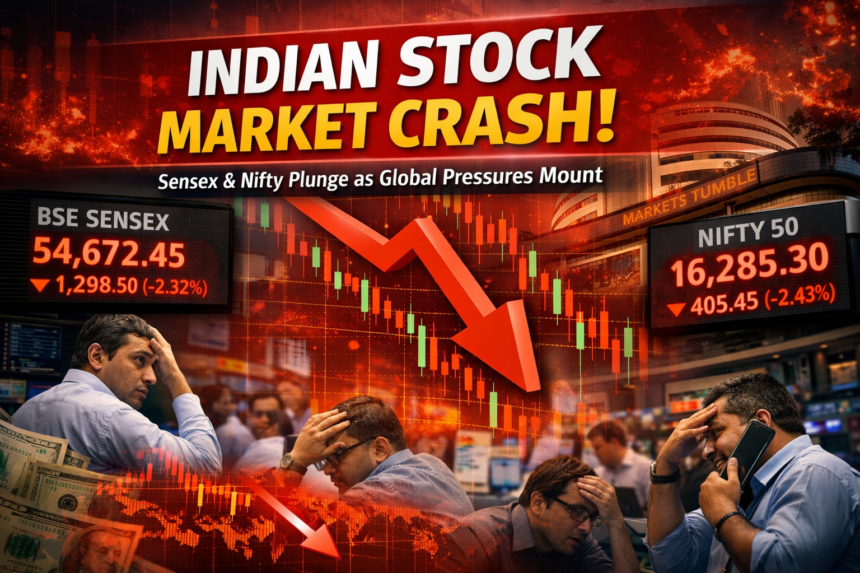
The Indian stock market witnessed a sharp decline today as benchmark indices Sensex and Nifty plunged steeply, reflecting mounting global pressures and weakening investor confidence. Heavy selling across sectors erased significant market capitalisation in a single session, making it one of the most volatile trading days in recent weeks.
The fall comes amid weak global cues, sustained foreign investor selling, concerns over high interest rates, and geopolitical uncertainty, all of which combined to trigger panic selling in domestic equities.
From the opening bell, Indian equity markets were under pressure. Both Sensex and Nifty opened sharply lower and extended losses as the session progressed. Selling intensified in heavyweight stocks, particularly in banking, IT, metals, and energy sectors.
Broader markets also mirrored the negative sentiment. Mid-cap and small-cap stocks fell sharply, with several counters hitting their lower circuit limits, indicating heightened risk aversion among retail investors.
Market experts described today’s fall as a broad-based sell-off, rather than a correction limited to specific stocks or sectors.
Global equity markets remained under pressure as investors reacted to economic uncertainty in major economies. Overnight losses in US and European markets set a negative tone for Asian markets, including India.
Fears of slowing global growth and tightening financial conditions have dampened risk appetite worldwide, directly impacting emerging markets.
Central banks across developed economies have indicated that interest rates may remain elevated for a longer period to control inflation. This has reduced expectations of early rate cuts, making equities less attractive compared to fixed-income instruments.
Higher interest rates increase borrowing costs for businesses and reduce corporate profitability, which negatively affects equity valuations.
Elevated US bond yields have prompted investors to shift funds towards safer assets. As a result, Foreign Institutional Investors (FIIs) continued to sell Indian equities aggressively, adding pressure to the market.
Sustained FII outflows often lead to short-term volatility, even when domestic fundamentals remain strong.
Ongoing geopolitical developments have increased uncertainty in global markets. Any escalation impacts crude oil prices, global trade, and currency movements — all of which have a direct bearing on the Indian economy.
Banking stocks were among the biggest losers today. Concerns over tighter global liquidity, higher funding costs, and reduced credit growth weighed heavily on both private and public sector banks.
IT stocks declined sharply amid fears of slowing demand from the US and Europe, which together contribute a major share of revenue for Indian IT companies.
Metal stocks fell as concerns over a global economic slowdown raised fears of lower demand for commodities. Energy stocks also faced pressure due to volatile crude oil prices.
After months of strong performance, mid-cap and small-cap stocks saw heavy profit booking, amplifying losses across the broader market.
Market volatility rose sharply, and investor sentiment turned cautious. Retail investors, who had been actively participating in recent market rallies, appeared nervous as prices declined rapidly.
Financial advisors urged investors to avoid panic selling and maintain a disciplined approach, highlighting that market corrections are a normal part of equity investing.
Market experts remain divided. While some believe the decline is a short-term correction driven by global factors, others caution that continued global uncertainty could keep markets under pressure in the near term.
Analysts suggest that investors should:
-
Focus on fundamentally strong stocks
-
Avoid leveraged positions
-
Maintain proper asset allocation
-
Invest gradually using staggered buying strategies
Despite today’s sharp fall, experts believe India’s long-term growth story remains intact. Strong domestic consumption, government-led infrastructure spending, and healthy corporate balance sheets continue to support the economy.
Domestic institutional investors (DIIs) are expected to provide some cushion against extreme volatility, even as foreign investors remain cautious.
Market participants are advised to closely monitor:
-
Global economic data and inflation trends
-
Central bank policy announcements
-
Crude oil price movements
-
FII and DII investment flows
Short-term volatility is likely to persist, but long-term investors are encouraged to stay invested and avoid emotional decision-making.
The sharp fall in Sensex and Nifty today highlights the strong influence of global factors on Indian stock markets. While short-term sentiment remains weak, seasoned investors see volatility as an opportunity rather than a threat.
As markets navigate through global uncertainty, patience, discipline, and a focus on fundamentals will be key for investors aiming to generate sustainable long-term returns.