

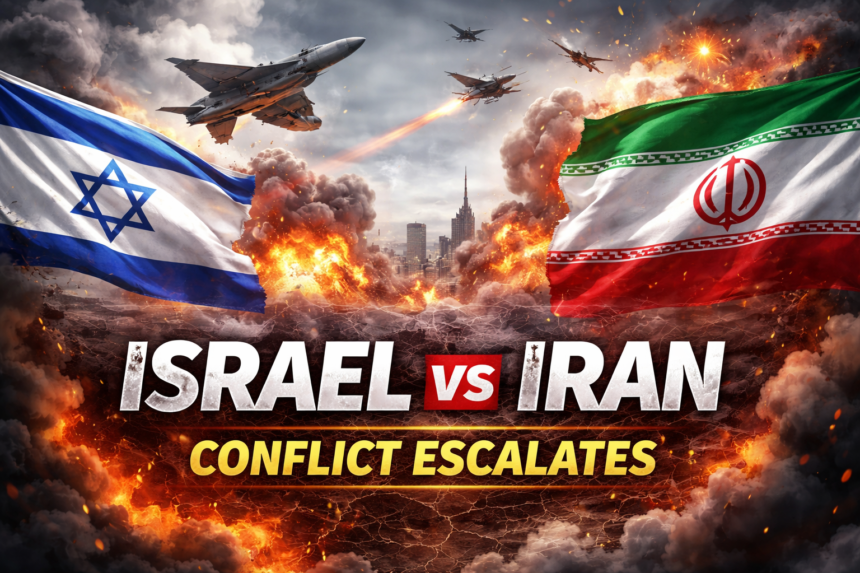
The ongoing conflict between Israel and Iran has entered its tenth day, with both sides launching intensified airstrikes and drone attacks across the Middle East. What began as a targeted military operation has rapidly evolved into a broader regional confrontation involving multiple countries, rising civilian casualties, and growing economic repercussions worldwide. As missile sirens echo across cities and air defenses scramble to intercept incoming threats, global leaders are warning that the crisis could escalate into a prolonged and destabilizing war.
The current escalation began on 28 February 2026, when Israel launched a large-scale military campaign known as Operation Lion’s Roar, targeting Iranian military infrastructure and strategic sites. The strikes were reportedly carried out with support from the United States and focused on missile facilities, command centers, and other sensitive locations in Iran.
During the operation, a series of airstrikes in Tehran killed several senior Iranian officials, including Supreme Leader Ali Khamenei. His death triggered significant political changes inside Iran and intensified hostilities with Israel and its allies.
Following the assassination and the Israeli strikes, Iran vowed retaliation and began launching missile and drone attacks across the region, targeting Israeli territory, U.S. military bases, and infrastructure in several Gulf nations. The conflict quickly expanded beyond the borders of the two countries, drawing in multiple regional actors.
As the war entered its tenth day, both sides continued to exchange heavy strikes. Israeli forces launched fresh air raids targeting Iranian military facilities and infrastructure, while Iran responded with waves of missiles and unmanned aerial vehicles (UAVs).
Iranian attacks have reportedly reached several countries in the Middle East, including Saudi Arabia, Kuwait, the United Arab Emirates, Bahrain, and Jordan, with many missiles intercepted by regional air defense systems. Some attacks, however, caused casualties and damage to civilian infrastructure.
In the United Arab Emirates, authorities reported multiple missile and drone strikes that killed several people and injured more than a hundred others. Debris from intercepted projectiles also damaged buildings in major cities such as Dubai.
Meanwhile, NATO and allied defense systems have intercepted several Iranian ballistic missiles entering the airspace of countries like Turkey and Jordan, highlighting the expanding geographic scope of the conflict.
Military analysts say the use of drones and missiles on such a large scale demonstrates a new phase of warfare in the region, where advanced technology allows strikes to occur hundreds or even thousands of kilometers from the original battlefield.
The humanitarian impact of the conflict is becoming increasingly severe. Reports indicate that more than 1,200 people have been killed in Iran, with hundreds more casualties in Lebanon and other parts of the region. Israeli cities have also experienced casualties due to missile strikes.
Large numbers of civilians have been displaced as people flee areas targeted by airstrikes. In Lebanon, intensified Israeli operations against groups aligned with Iran have forced thousands to leave their homes, creating growing pressure on humanitarian organizations and local governments.
Hospitals across affected areas are struggling to cope with the influx of wounded civilians, while power outages, damaged infrastructure, and shortages of medical supplies are worsening the crisis.
Beyond the battlefield, the conflict is already having significant economic consequences. The Middle East is home to some of the world’s most important oil and gas production facilities, and attacks on energy infrastructure have triggered alarm across global markets.
Oil prices surged past $100 per barrel, with brief spikes close to $120 as investors feared disruptions to energy supplies. Analysts say that prolonged instability could push prices even higher, potentially leading to inflation and economic slowdowns in many countries.
The conflict also threatens critical shipping routes, particularly the Strait of Hormuz, a narrow waterway through which nearly one-fifth of the world’s oil supply passes. Any disruption in this route could significantly affect global trade and energy distribution.
Financial markets have already reacted nervously to the escalating situation, with stock markets in several countries experiencing sharp declines.
Governments around the world are closely monitoring the crisis. Several countries have urged restraint and called for immediate diplomatic efforts to prevent the conflict from escalating further.
France has reportedly deployed naval assets to protect shipping routes and energy infrastructure in the region, while China and other global powers have warned that continued escalation could destabilize the global economy.
Meanwhile, some nations have begun evacuating diplomatic staff and non-essential personnel from high-risk areas, highlighting the seriousness of the situation.
Despite international calls for de-escalation, there are currently few signs that the conflict will end soon. Both Israel and Iran have indicated that they are prepared for a prolonged confrontation, raising concerns about a wider regional war involving additional countries and armed groups.
Military experts warn that continued attacks on energy infrastructure and strategic shipping routes could further destabilize the global economy, while the humanitarian toll may continue to rise.
For now, the Middle East remains on edge as the world watches closely, hoping diplomatic efforts can prevent the crisis from spiraling into an even more destructive conflict.