



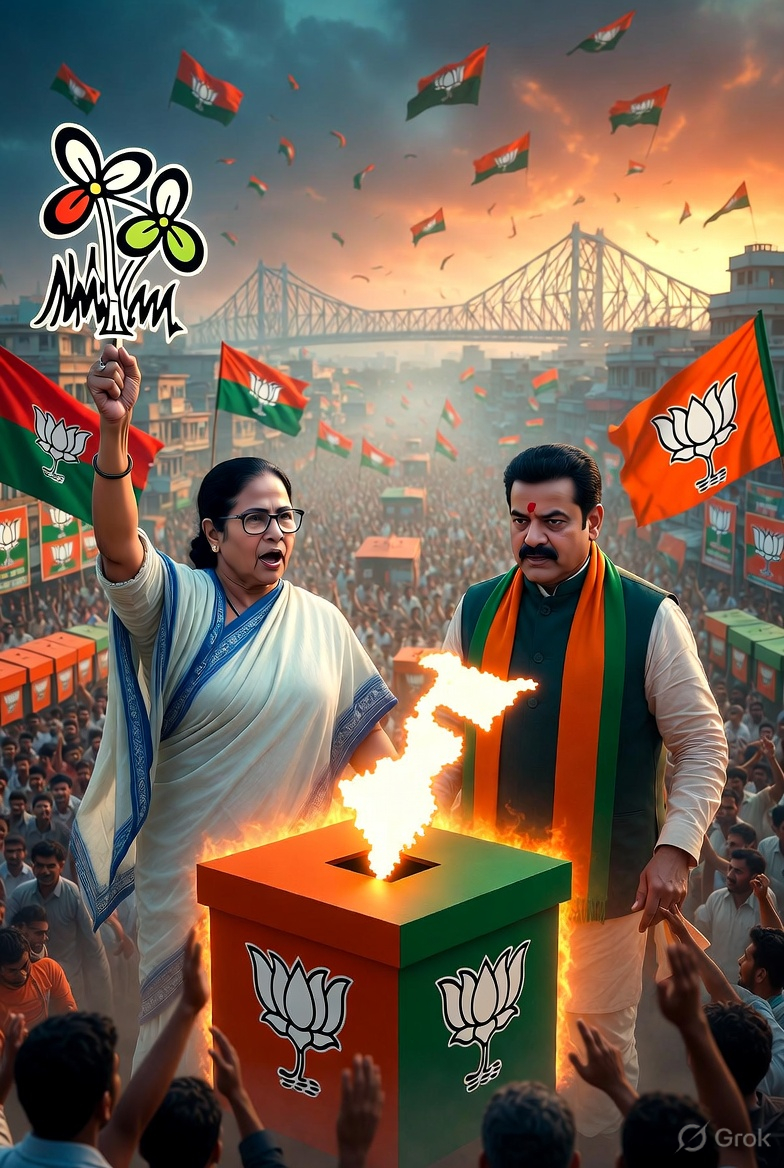
The West Bengal Legislative Assembly election of 2026 is shaping up to be one of the most intense and closely watched political contests in India. Set for two phases on April 23 and April 29, 2026, with results expected on May 4, the polls will decide control over all 294 seats in the state assembly. A party or alliance needs at least 148 seats to form the government. This election comes after 15 years of continuous rule by the All India Trinamool Congress (TMC) under Chief Minister Mamata Banerjee, who is aiming for a rare fourth consecutive term. On the other side, the Bharatiya Janata Party (BJP) is mounting a strong challenge, hoping to capitalize on anti-incumbency and expand its base in eastern India.
Background from the 2021 Polls
In the 2021 assembly elections, TMC delivered a decisive victory, winning around 215 seats with nearly 48% of the popular vote. The BJP emerged as the main opposition, securing 77 seats and about 38% votes — a massive jump from just three seats in 2016. The Left Front and Congress were almost completely sidelined. Many seats were decided by very narrow margins, with dozens of constituencies seeing victories by less than 5,000 votes. This made booth-level management, local issues, and voter turnout critical factors. The 2026 battle builds on that razor-thin competition, especially in rural and semi-urban areas where swings of a few percentage points can change outcomes.
Key Contenders and Campaign Strategies
Mamata Banerjee remains the undisputed face of TMC. The party has released candidates for 291 seats, leaving three hill constituencies in Darjeeling for its ally, the Bharatiya Gorkha Prajatantrik Morcha. TMC has dropped several sitting MLAs to address anti-incumbency and has emphasized inclusive candidate selection, including a significant number of women, youth, and candidates from SC, ST, and minority communities. The campaign revolves around protecting “Bengali pride” (Bangla Nijer Meye), highlighting welfare schemes for women, farmers, and the poor, and portraying the election as a fight against outside interference. Mamata herself is contesting from her traditional Bhabanipur seat in Kolkata, where she faces a direct challenge from BJP’s Leader of Opposition Suvendu Adhikari — turning it into one of the most symbolic and high-voltage contests.
The BJP, led aggressively by Suvendu Adhikari, is positioning itself as the agent of change. Adhikari is contesting from both his stronghold Nandigram and against Mamata in Bhabanipur, a bold move aimed at pinning down the Chief Minister and energizing the party’s base. The party has released multiple candidate lists featuring prominent faces and is focusing on issues like governance failures, corruption scandals (such as those in recruitment and ration distribution), unemployment, and alleged demographic changes. BJP leaders accuse TMC of “appeasement politics” and misusing state machinery, while promising better investment, jobs, and development. National leaders, including Prime Minister Narendra Modi, are expected to campaign heavily.
Smaller parties like the Left Front (CPI(M) and allies) and Congress are contesting independently after their alliance collapsed. They have announced candidates but lack the organizational muscle they once had. Their presence might fragment votes in some pockets, but the contest largely remains bipolar between TMC and BJP. In the hills, regional dynamics with Gorkha groups add another layer.
Major Issues in the Campaign
Several hot-button topics dominate the discourse:
- Voter List Revision: The Election Commission’s Special Intensive Revision led to deletions of names, which TMC claims disproportionately affects minorities and migrants. BJP views it as removing bogus entries. This has sparked protests and legal battles.
- Anti-Incumbency: After three terms, TMC faces questions over industrialization slowdown, youth unemployment, and allegations of “cut money” in welfare schemes. Incidents like the RG Kar hospital case have fueled urban discontent.
- Security and Polarization: Bengal has a history of poll-related violence. The Commission has deployed massive central forces to ensure peaceful voting. Debates over religious polarization, migration, and cultural identity remain sharp.
- Welfare vs. Governance: TMC highlights schemes supporting women and rural households, while BJP attacks on corruption and promises “good governance.”
Local factors — such as Matua community consolidation, rural distress, and aspirations in Jangalmahal or North Bengal — also influence outcomes.
Why This Election Matters
For TMC, victory would mean continuing its regional dominance and strengthening the voice of federalism. For BJP, success in Bengal would mark a major breakthrough in a state long considered difficult terrain and could reshape national politics. The election tests whether long-term incumbency can be overcome by aggressive opposition or whether TMC’s deep grassroots network and welfare delivery will prevail.
Analysts point out that while TMC enjoys strong organizational depth, the BJP has gained ground through consistent campaigning and consolidation of certain vote banks. The narrow-margin seats from 2021 will once again be the real battlegrounds. With heavy security in place and webcasting at polling booths, the focus is on ensuring a free and fair process.
As campaigning reaches fever pitch with rallies, roadshows, and door-to-door efforts, Bengal’s voters — over 70 million strong — hold the key. The outcome on May 4 will not only decide the next government in Kolkata but also send strong signals about the balance between regional aspirations and national currents in Indian democracy.
In the end, the Bengal election of 2026 is more than a state poll. It is a clash of personalities, ideologies, and visions for the future of one of India’s most culturally rich and politically vibrant states.