

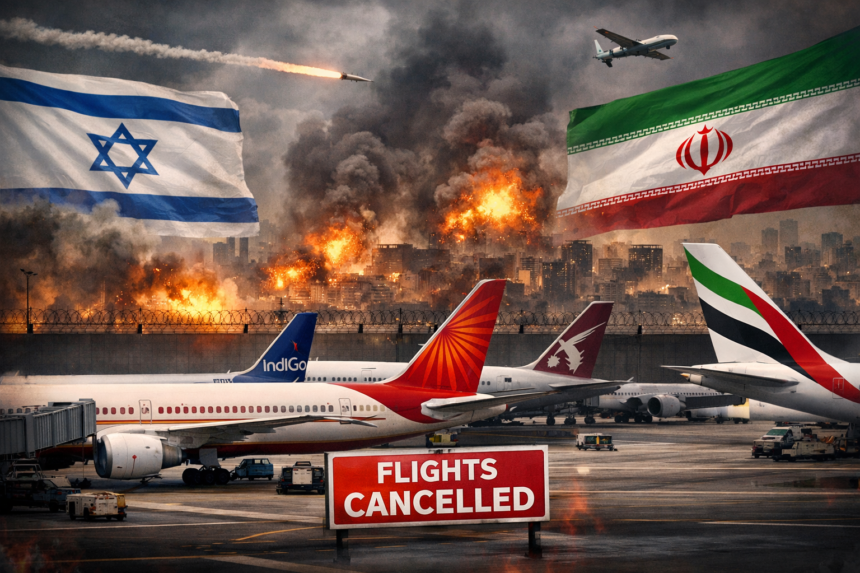
Global aviation has entered a period of major uncertainty as escalating tensions between Israel and Iran trigger widespread airspace closures across the Middle East. Major airlines including Air India, IndiGo, Emirates, Qatar Airways, and several European carriers have cancelled or suspended flights, leaving thousands of passengers stranded and disrupting international travel routes worldwide.
The rapidly evolving geopolitical crisis has forced aviation authorities and airlines to prioritize passenger safety, resulting in one of the largest travel disruptions since the pandemic-era shutdowns. As military tensions intensify, the ripple effects are being felt far beyond the conflict zone, impacting global tourism, business travel, and airline operations.
The current aviation disruption stems from escalating military actions between Israel and Iran, including missile and drone attacks that have heightened security risks across regional airspace. Several countries—including Iran, Iraq, Israel, Kuwait, and parts of the Gulf region—have imposed airspace restrictions or temporary closures to ensure civilian aircraft safety.
Because the Middle East serves as a critical aviation corridor connecting Asia, Europe, and Africa, even limited closures can severely affect global flight networks. Airlines rely heavily on these routes for long-haul travel, making rerouting difficult and costly.
Reports indicate that thousands of flights were cancelled or delayed within days, with major airport hubs such as Dubai, Doha, and Abu Dhabi experiencing operational shutdowns or limited services.
Several global carriers have issued travel advisories and suspended services temporarily:
-
Air India halted flights to destinations including the UAE, Qatar, Saudi Arabia, and Israel.
-
IndiGo suspended flights using Middle Eastern airspace until safety conditions improve.
-
Emirates and Etihad Airways paused operations from their UAE hubs due to airspace restrictions.
-
Qatar Airways temporarily grounded flights after Qatari airspace closures.
-
European airlines such as Lufthansa, Air France, and KLM also cancelled routes across the region.
Indian airports have already reported dozens of cancellations, with passengers advised to check airline updates before travelling.
In many cases, airlines are offering refunds, free rescheduling, or travel waivers to affected customers.
Aviation authorities consider conflict zones among the highest risks for civilian aircraft. Missile activity and military operations can create unpredictable hazards, prompting airlines to suspend flights even if airports remain open.
Large portions of Middle Eastern airspace have become nearly empty as airlines avoid flying over sensitive regions.
Experts note that airlines must comply with international aviation safety protocols, which require immediate operational changes whenever conflict threatens air routes. This includes:
-
Flight cancellations
-
Route diversions
-
Technical fuel stops on longer routes
-
Reduced flight frequency
Some airlines have begun using alternative routes to Europe and North America, increasing travel time and operational costs.
The crisis has stranded tens of thousands of travelers worldwide. Tourists, migrant workers, and business travelers have been affected as connecting flights through major Middle Eastern hubs were cancelled.
Governments across Europe and Asia are issuing travel advisories and organizing repatriation flights for citizens stuck abroad. Limited “special flights” are being operated to bring passengers home while commercial services remain suspended.
Travel companies and airlines are facing logistical challenges such as:
-
Crew displacement across continents
-
Airport congestion
-
Increased ticket prices on alternative routes
-
Hotel shortages for stranded passengers
Industry analysts warn that prolonged disruption could significantly impact airline revenues and global tourism recovery.
The aviation crisis is already affecting global markets. Airline stocks and travel-sector companies have seen volatility as uncertainty grows. Meanwhile, oil prices have surged amid fears that regional instability could disrupt shipping routes through the Strait of Hormuz—one of the world’s most critical energy corridors.
Higher fuel costs combined with longer flight routes may also increase airfare prices globally in the coming weeks.
Airlines are cautiously monitoring security developments before restoring normal operations. Some carriers expect partial flight resumptions within days, while others may wait until early March or later depending on regional stability.
Aviation authorities emphasize that passenger safety remains the top priority, meaning schedules could change at short notice.
Travel experts recommend passengers:
-
Check flight status directly with airlines before leaving for airports
-
Opt for flexible booking options
-
Monitor government travel advisories
-
Keep travel insurance details accessible
-
Prepare for possible delays or rerouting
Passengers traveling through Middle Eastern hubs should remain especially cautious until airspace restrictions are lifted.
The escalating Israel–Iran conflict has demonstrated how geopolitical tensions can instantly disrupt global aviation networks. With airlines cancelling flights and major airspaces closed, international travel faces significant uncertainty in the short term.
While limited services are gradually resuming, the situation remains fluid. Airlines, governments, and travelers alike are navigating a rapidly changing environment where safety concerns outweigh operational convenience.
As diplomatic developments unfold, the reopening of Middle Eastern skies will play a crucial role in restoring stability to global travel and aviation.