
Tensions in Bangladesh have boiled over into widespread protests, violent clashes, and anti-India sentiment following the death of prominent political activist Sharif Osman Hadi — triggering one of the most tumultuous chapters in the country’s recent history.
Sharif Osman Hadi, a 32-year-old spokesperson for the Inqilab Moncho movement and a leading figure in the 2024 student-led uprising that toppled former Prime Minister Sheikh Hasina, died on December 18, 2025, in a Singapore hospital after being critically wounded in an assassination attempt in Dhaka earlier last week. His death has ignited nationwide demonstrations, attacks on media houses, and unprecedented political unrest spread across major cities including Dhaka, Chittagong, Gazipur, and Rajshahi.
Sharif Osman Hadi had emerged as a popular and influential activist within Bangladesh’s youth and student movements. He played a central role in the July 2024 uprising — a mass pro-democracy movement that ended the 15-year rule of Sheikh Hasina and ushered in an interim government led by Nobel laureate Muhammad Yunus. As a vocal critic of both domestic political oppression and perceived Indian influence, Hadi built a following across student circles and grassroots activists.
Before his death, Hadi was planning to contest the upcoming February 2026 parliamentary elections as an independent candidate in the Dhaka-8 constituency, underlining his emerging role as a national political figure.
On December 12, 2025, Hadi was shot in broad daylight by masked gunmen while traveling in Dhaka. The attackers reportedly fled the scene on a motorcycle. Hadi was initially treated at Dhaka Medical College Hospital and later transferred to Singapore General Hospital in critical condition. Despite intensive treatment, he succumbed to his injuries just over a week after the attack.
The assassination instantly sparked anger and shock across Bangladesh. His supporters and many citizens viewed the killing not just as an attack on an individual but on the broader struggle for justice and national sovereignty. Rumors and unverified reports circulated that the shooter may have escaped into India, further inflaming nationalist sentiment and significantly straining bilateral perceptions.
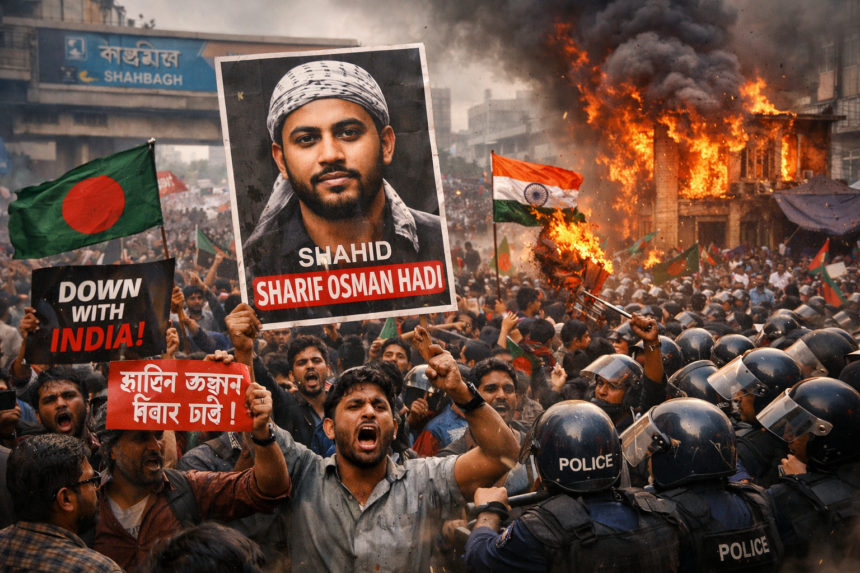
Within hours of the announcement of Hadi’s death, tens of thousands of people poured into the streets, particularly in Dhaka’s Shahbagh Square, demanding justice and accountability for his assassination. In many areas, what began as peaceful marches rapidly escalated into large-scale demonstrations marked by arson, vandalism, and intense confrontations with security forces.
In several parts of the capital, mobs attacked the offices of major newspapers — including Prothom Alo and The Daily Star — brandishing them as pro-India or anti-Bangladesh. Buildings were set on fire, equipment was looted or destroyed, and journalists were trapped inside until emergency evacuations could be organized. The violence against media outlets represents a chilling indicator of deteriorating press freedom amid political chaos.
Demonstrators also targeted cultural institutions and political party offices. Vandalism was reported at the Bangladesh Shilpakala Academy, and the homes of political figures were attacked in cities like Chattogram. Protestors even pressured diplomatic missions, including an attack on the Indian Assistant High Commission in Chittagong, underscoring how deeply the unrest has intertwined with anti-India sentiment.
Though the roots of the protests are complex, a significant factor driving the unrest is rising anti-India sentiment. Hadi’s political identity was closely tied to opposition against perceived Indian political influence in Bangladesh — particularly its impact on internal affairs, electoral politics, and past government alignments. Following his death, many protestors blamed external actors and raised accusations about India’s alleged role in sheltering Hadi’s suspected killer, though official statements on this remain unverified.
In some rallies, chants against Indian influence became prominent, reflecting longstanding tensions between nationalist segments of Bangladeshi society and New Delhi. Attacks on Indian diplomatic properties further symbolize how rapidly political grief has shifted into broader geopolitical resentment.
Facing escalating unrest, the interim government led by Muhammad Yunus declared a national day of mourning as Hadi’s funeral drew massive crowds to Dhaka’s Parliament area and Dhaka University where he was laid to rest beside national poet Kazi Nazrul Islam. Security forces were deployed throughout the capital to manage the volatile situation and prevent further escalation
Government officials have condemned the violence and urged citizens to maintain order, even as they investigate the shooting. Seven arrests connected to other episodes of unrest — including unrelated mob violence — were reported, highlighting the broader challenge authorities face in restoring peace.
The unrest comes at a critical moment, as Bangladesh prepares for parliamentary elections in February 2026 — a contest seen as a pivotal step in the nation’s return to democratic governance. Political analysts warn that continued violence could jeopardize election preparations, weaken democratic institutions, and embolden fringe groups.
Human rights organizations — including Amnesty International and Human Rights Watch — have expressed concern over the spiraling violence and attacks on press freedom, urging impartial investigations and protection for journalists and civilians caught in the unrest.
Sharif Osman Hadi’s death has laid bare longstanding political fractures in Bangladesh — between youth movements and establishment forces, nationalist sentiments and foreign policy complexities, and the delicate balance between protest and violence. As protests continue and anti-India rhetoric gains momentum, the government faces the formidable task of navigating a pathway to peace without further polarizing an already volatile society.
The coming weeks will be crucial for Bangladesh’s democratic trajectory, and whether the momentum from these protests transforms into lasting political change or deeper instability remains to be seen. Mobilizing dialogue, ensuring justice, and strengthening democratic safeguards may prove essential for healing a divided nation.