


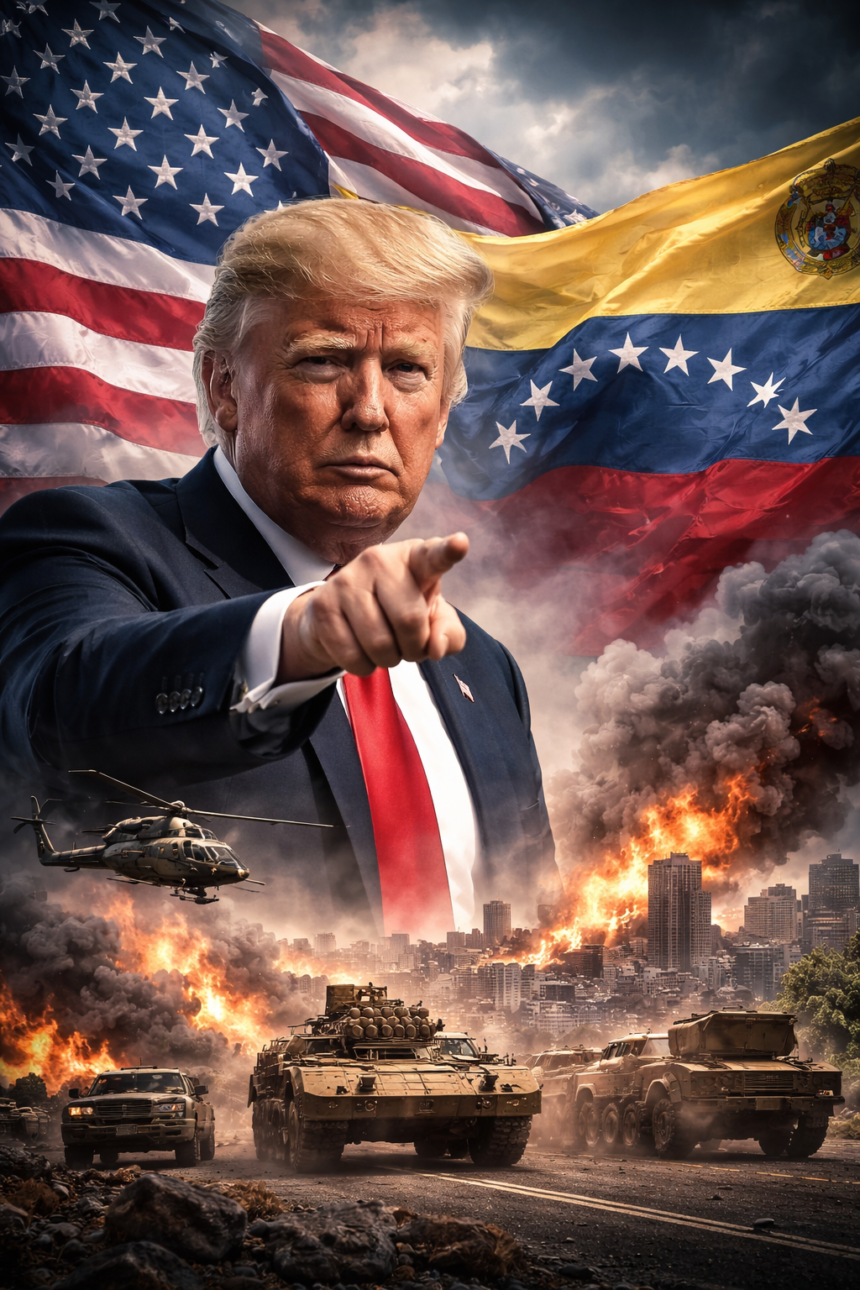
Donald Trump’s approach toward Venezuela stands out as one of the most confrontational U.S. foreign policies in Latin America in recent history. While it did not result in a full-scale military invasion, Trump’s actions are often described as an “attack” due to the intensity of economic sanctions, diplomatic isolation, political intervention, and repeated threats of force aimed at overthrowing the Venezuelan government led by President Nicolás Maduro.
Background of the Conflict
When Donald Trump took office in 2017, Venezuela was already experiencing a deep political and economic crisis. Years of economic mismanagement, declining oil production, corruption, and authoritarian governance had led to hyperinflation, food shortages, and mass migration. Millions of Venezuelans fled to neighboring countries, creating a regional humanitarian crisis.
The Trump administration viewed Nicolás Maduro’s government as illegitimate, especially after Venezuela’s 2018 presidential election, which the U.S. and many Western nations claimed lacked transparency and fairness. This perception laid the foundation for an aggressive U.S. stance against Caracas.
Economic Sanctions as a Weapon
The most powerful element of Trump’s “attack” on Venezuela was economic pressure. The U.S. imposed harsh sanctions on Venezuela’s oil industry, state-owned enterprises, and senior government officials. Since oil exports were Venezuela’s main source of revenue, these measures severely restricted the government’s ability to earn foreign currency.
Trump’s administration argued that sanctions were necessary to weaken Maduro’s grip on power and push the country toward democratic reform. However, critics claimed that these sanctions worsened living conditions for ordinary citizens by limiting access to food, medicine, and essential services.
Political Intervention and Opposition Support
In January 2019, Trump openly supported opposition leader Juan Guaidó, recognizing him as Venezuela’s legitimate interim president. This move was highly controversial and marked a direct political challenge to Maduro’s authority.
The U.S. froze Venezuelan government assets under its control and redirected some resources to the opposition. Trump officials openly encouraged Venezuela’s military and political elite to abandon Maduro, hoping internal pressure would force regime change. Despite international backing from several countries, the opposition failed to gain control, and Maduro remained in power.
Diplomatic Isolation and International Pressure
Trump also worked to isolate Venezuela on the global stage. His administration pushed Latin American allies, the Organization of American States (OAS), and European partners to condemn Maduro’s government. Venezuela was portrayed as a threat to democracy, regional stability, and U.S. security interests.
At the same time, Trump framed the crisis as part of a larger ideological battle, accusing Venezuela of aligning with America’s rivals such as Russia, China, Cuba, and Iran. This narrative helped justify Washington’s hard-line position.
Military Threats and Strong Rhetoric
One of the most alarming aspects of Trump’s policy was his repeated claim that “all options are on the table,” including military action. Although no direct invasion occurred, the rhetoric itself was seen as a psychological and political attack designed to intimidate the Venezuelan leadership.
These statements sparked concern across Latin America, where memories of past U.S. interventions remain strong. Critics argued that such threats strengthened Maduro’s domestic narrative that Venezuela was under foreign aggression.
Results and Limitations
Despite unprecedented pressure, Trump’s strategy did not succeed in removing Nicolás Maduro from power. The Venezuelan military largely stayed loyal, opposition unity weakened over time, and international support for aggressive sanctions gradually declined.
The crisis also revealed the limits of unilateral pressure. While the U.S. exerted significant influence, it could not fully control outcomes inside Venezuela, especially with continued backing from Maduro’s allies.
Conclusion
Trump’s attack on Venezuela was not a traditional war, but it was a forceful campaign using economic sanctions, political pressure, diplomatic isolation, and military threats. It reshaped U.S.–Venezuela relations and signaled a return to hard-power tactics in Latin America.
Ultimately, the policy highlighted a key lesson in global politics: pressure alone, without internal consensus and sustained diplomacy, may weaken a government but does not always bring about regime change. Venezuela remains a powerful example of both the reach—and the limits—of American influence in the modern world.