


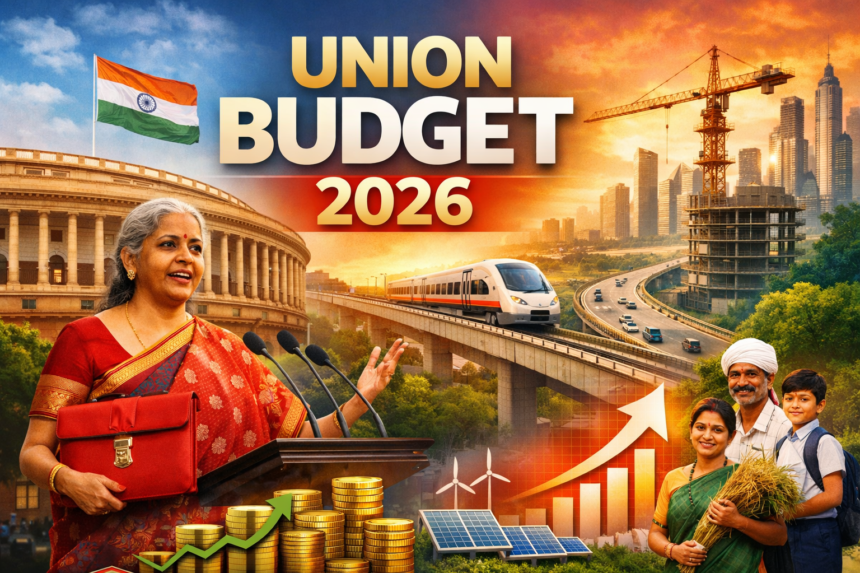
India witnessed a major policy moment today as Budget 2026 announcements rolled out across the country, setting the tone for the nation’s economic and social priorities for the coming financial year. Presented in Parliament amid high expectations from citizens, businesses, and global investors, the Union Budget 2026 aims to balance economic growth, fiscal discipline, and inclusive development.
Finance Minister Nirmala Sitharaman outlined a roadmap that focuses on strengthening India’s macro-economic stability while accelerating investments in infrastructure, social welfare, and future-ready sectors such as digital governance, green energy, and innovation.
At its core, Budget 2026 reflects the government’s commitment to sustaining India’s growth momentum in an uncertain global environment. With inflationary pressures, geopolitical challenges, and slowing global demand still posing risks, the budget emphasizes domestic demand, job creation, and long-term productivity.
Economic experts note that the budget continues the government’s strategy of using public capital expenditure as a growth engine, while simultaneously encouraging private sector participation through policy stability and targeted incentives.
One of the strongest pillars of Budget 2026 is infrastructure development. The government has proposed enhanced allocations for:
-
Transport and logistics, including highways, railways, and multimodal connectivity
-
Urban infrastructure, focusing on smart cities, metro rail expansion, and affordable housing
-
Rural infrastructure, aimed at improving roads, irrigation, and digital connectivity
These measures are expected to not only improve ease of doing business but also generate large-scale employment across construction, manufacturing, and allied sectors.
The continued focus on infrastructure aligns with India’s long-term goal of becoming a $5-trillion economy, while also reducing regional disparities and strengthening supply chains.
Budget 2026 places significant emphasis on social provisions, reinforcing the government’s commitment to inclusive development. Key focus areas include:
Increased funding for school education, skill development programs, and digital learning platforms aims to prepare India’s youth for a rapidly evolving job market. Special attention has been given to vocational training and industry-linked skilling initiatives.
The budget highlights strengthened healthcare infrastructure, particularly at the primary and district levels. Preventive healthcare, digital health records, and expanded insurance coverage remain central themes.
Farmers and rural communities continue to be a priority, with provisions aimed at improving agricultural productivity, supporting agri-tech adoption, and ensuring better access to credit and markets.
Recognizing the role of small businesses in employment generation, Budget 2026 introduces supportive measures for MSMEs and startups, including:
-
Easier access to credit
-
Policy support for technology adoption
-
Simplification of compliance requirements
The manufacturing sector, especially under the “Make in India” vision, is expected to benefit from incentives focused on value addition, exports, and domestic production.
The budget continues India’s push toward a digital-first economy. Initiatives around digital public infrastructure, fintech innovation, and e-governance have been reinforced to improve service delivery and transparency.
Technology-driven reforms are also expected to strengthen India’s position as a global hub for IT services, startups, and digital innovation.
Environmental sustainability features prominently in Budget 2026. Allocations and policy announcements related to:
-
Renewable energy and clean mobility
-
Climate-resilient infrastructure
-
Energy efficiency and green finance
signal the government’s intent to align economic growth with climate commitments and sustainable development goals.
Initial reactions to Budget 2026 suggest cautious optimism. Industry bodies have welcomed the continued focus on infrastructure and capital expenditure, while economists view the balanced approach as supportive of long-term growth.
For citizens, the emphasis on social welfare, employment generation, and public services is expected to have a direct impact on quality of life, particularly for middle-income and vulnerable groups.
As Budget 2026 announcements continue to be analyzed in detail, its real impact will unfold over the coming months through implementation and policy execution. The budget sets a clear direction: growth with stability, development with inclusion, and progress with sustainability.
With infrastructure investment, social sector strengthening, and digital innovation at its core, Budget 2026 aims to position India as a resilient and forward-looking economy in an increasingly complex global landscape.