

- 0Shares
- 5 Views
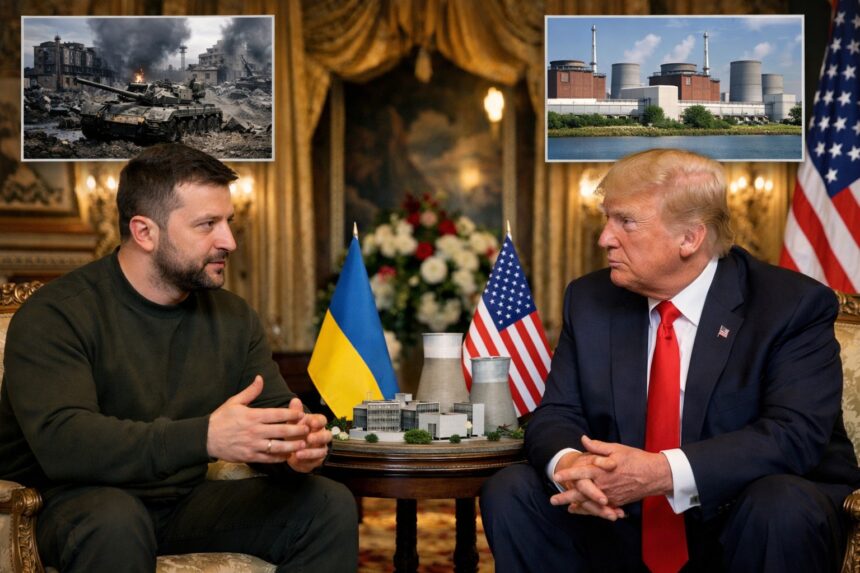
In a significant development with global implications, Ukrainian President Volodymyr Zelenskyy is set to meet former U.S. President Donald Trump at Mar-a-Lago to discuss a potential peace framework aimed at ending the prolonged Russia–Ukraine conflict. The talks are expected to focus on critical flashpoints such as the eastern Ukrainian region of Donbas and the strategically vital Zaporizhzhia Nuclear Power Plant, underscoring the urgency of stabilizing both territorial and energy-security risks.
As the conflict stretches on, diplomatic channels have intensified amid mounting human, economic, and geopolitical costs. The Zelenskyy–Trump meeting represents a notable pivot toward exploring alternative diplomatic avenues. While the United States remains Ukraine’s most important international partner, the involvement of a former U.S. president—particularly one who has indicated interest in brokering deals—adds a new layer to the peace discourse.
For Kyiv, the goal is clear: restore sovereignty, ensure security guarantees, and prevent further territorial losses. For Washington and its allies, the objective is to secure a sustainable peace that preserves international law while minimizing escalation risks.
Holding talks at Mar-a-Lago is symbolic as well as strategic. The Florida estate has frequently served as a venue for high-profile diplomatic interactions. Meeting there highlights the informal yet consequential nature of the discussions, suggesting exploratory diplomacy rather than formal treaty negotiations. It also signals that peace talks may increasingly involve unconventional channels alongside official government diplomacy.
The Donbas region—comprising parts of Donetsk and Luhansk—has been the epicenter of hostilities since 2014 and remains one of the most contentious issues in any peace plan. Rich in industrial resources and strategically located, Donbas has immense economic and political significance for Ukraine.
Any peace proposal discussed at Mar-a-Lago is likely to address:
-
Territorial control and governance of occupied areas
-
Security guarantees to prevent renewed aggression
-
Humanitarian access and reconstruction for war-affected communities
Ukraine has consistently stated that any lasting peace must include the full restoration of its territorial integrity, while Russia’s stance on Donbas continues to complicate negotiations.
The Zaporizhzhia Nuclear Power Plant, Europe’s largest nuclear facility, has become a focal point of international anxiety. Its occupation and proximity to active fighting have raised fears of a nuclear accident with transboundary consequences.
During the Zelenskyy–Trump discussions, the plant is expected to feature prominently, with possible proposals including:
-
Demilitarization of the plant and surrounding areas
-
International oversight by global nuclear watchdogs
-
Guaranteed safety corridors for technicians and inspectors
Stabilizing Zaporizhzhia is not only crucial for Ukraine’s energy supply but also for broader European and global security.
Donald Trump has previously stated that he could help bring the war to an end through negotiations, a claim that has drawn both interest and skepticism. Supporters view his involvement as an opportunity for pragmatic deal-making, while critics warn that any settlement must avoid legitimizing territorial aggression.
International reactions to the meeting have been mixed:
-
European allies emphasize that Ukraine must lead any peace process
-
NATO members stress that security guarantees are essential
-
Global markets are watching closely, as peace talks could ease energy and commodity volatility
Regardless of political differences, the meeting highlights a growing consensus that prolonged conflict benefits no one.
While details remain undisclosed, analysts suggest a potential framework could include:
-
Ceasefire mechanisms monitored by international observers
-
Phased withdrawal of forces from key contested zones
-
Negotiated status discussions for disputed territories under international law
-
Long-term security assurances backed by Western partners
-
Reconstruction and economic aid for Ukraine’s recovery
Each of these elements carries significant challenges, but even preliminary discussions mark progress after months of battlefield stalemate.
If successful, the Zelenskyy–Trump meeting could reinvigorate diplomatic momentum and open doors for broader multilateral negotiations. Even if no immediate breakthrough occurs, the talks signal that all sides are reassessing strategies amid war fatigue and global pressure.
For Ukraine, peace talks do not mean compromise on sovereignty but rather an effort to secure a future free from constant conflict. For the international community, the outcome could reshape security architecture in Europe for decades to come.
The upcoming meeting between Volodymyr Zelenskyy and Donald Trump at Mar-a-Lago represents more than a high-profile diplomatic encounter—it reflects a critical moment in the search for peace in Ukraine. With Donbas and the Zaporizhzhia Nuclear Power Plant at the center of discussions, the talks underscore the complex intersection of territorial integrity, energy security, and global stability. As the world watches closely, this diplomatic push may prove to be a stepping stone toward ending one of the most consequential conflicts of the 21st century.