

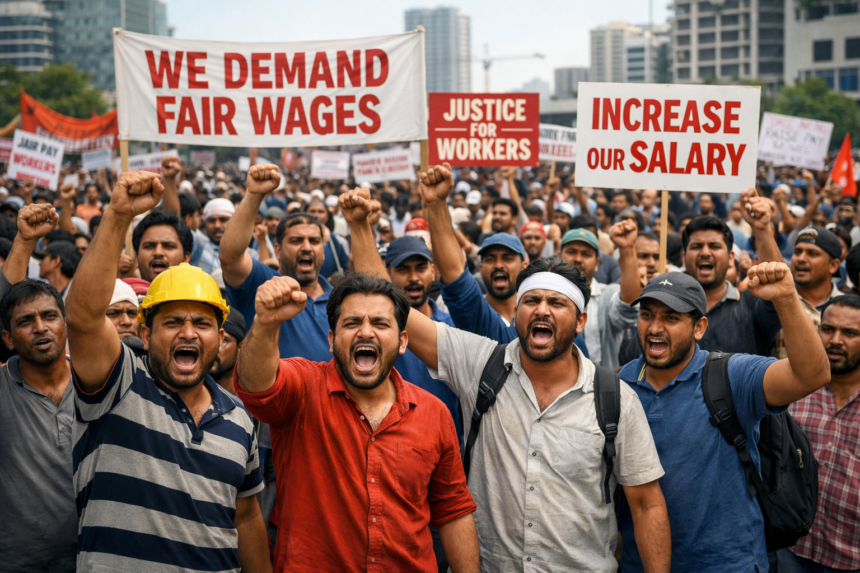
Noida, one of India’s प्रमुख industrial and IT hubs, recently witnessed a significant workers’ strike that drew attention to labor issues in rapidly growing urban economies. The strike was primarily driven by demands for higher wages, better working conditions, and stronger enforcement of labor rights. A large number of workers from factories and industrial units came together to express their concerns and push for change.
Thousands of workers in Noida are employed in sectors such as electronics, manufacturing, textiles, and logistics. Despite contributing significantly to industrial output, many workers have long faced challenges like low wages, job insecurity, and difficult working environments. With the rising cost of living, workers argue that their current salaries are no longer sufficient to meet basic needs, prompting them to organize and protest.
During the strike, workers gathered in groups, carrying banners and placards that highlighted their demands. They raised slogans and marched peacefully through industrial areas, seeking attention from both employers and government authorities. Key demands included an increase in minimum wages, timely salary payments, fair compensation for overtime, and improved workplace safety standards.
The strike had a noticeable impact on local industries. Several factories experienced disruptions in production as workers halted operations. This led to delays in supply chains and raised concerns among business owners. Industry representatives expressed the need for a quick resolution, acknowledging both the importance of maintaining productivity and addressing workers’ grievances.
Authorities took steps to ensure that the situation remained under control. Police personnel were deployed in key areas to maintain law and order and prevent any escalation. At the same time, efforts were made by local प्रशासन to facilitate dialogue between workers and management. The aim was to reach a peaceful and mutually acceptable solution through negotiation.
This strike has once again highlighted the broader issue of labor welfare in rapidly industrializing regions. While cities like Noida continue to grow economically, it is equally important to ensure that workers benefit from this growth. Ignoring their concerns can lead to repeated disruptions, affecting both productivity and social stability.
Experts believe that such strikes are not isolated incidents but indicators of deeper structural issues within labor systems. They emphasize the need for policy reforms, better implementation of labor laws, and open communication between employers and employees. Creating a balanced approach that supports both industrial growth and worker welfare is essential for sustainable development.
In conclusion, the Noida strike is more than just a local protest—it reflects the ongoing struggle of workers for dignity, fair pay, and safe working conditions. It serves as a reminder that true progress lies not only in economic expansion but also in ensuring justice and equality for the workforce that drives it.