



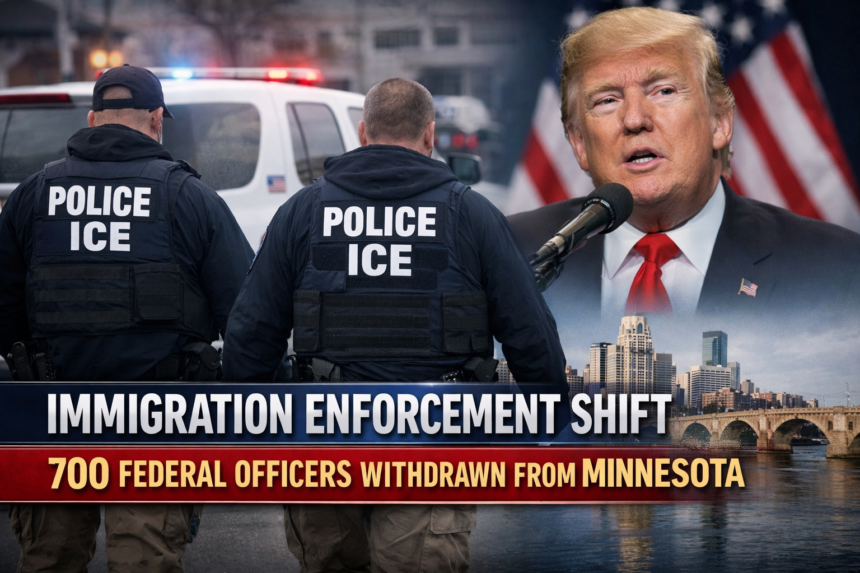
In a significant pivot of U.S. immigration policy, the Trump administration announced the withdrawal of about 700 federal immigration enforcement officers from Minnesota, reducing the federal footprint in the state while stressing that immigration operations will continue across the country. The move, confirmed by White House border czar Tom Homan, comes amid sustained protests, intense political debate and public scrutiny over federal immigration tactics in Minneapolis and throughout the state.
The reduction in federal agents — roughly a quarter of the approximately 3,000 officers deployed in Minnesota — was described by Homan as a result of “unprecedented cooperation” between federal agencies and state and local authorities. According to officials, Minnesota county jails have agreed to notify Immigration and Customs Enforcement (ICE) when individuals eligible for deportation are released following arrest, thus reducing the need for officers to conduct street operations.
“We are not surrendering our mission,” Homan told reporters during a news conference in Minneapolis. “We’re making it more effective and more strategic, relying on improved local collaboration to manage enforcement in safer, more targeted ways.”
Despite this reduction, he emphasized that around 2,000 federal immigration officers will still remain in Minnesota, far above pre-surge levels, and that enforcement efforts are ongoing.
The deployment of thousands of ICE and Customs and Border Protection (CBP) agents to Minnesota was part of a broader initiative known as Operation Metro Surge, launched in December 2025. The large-scale operation was described by the Department of Homeland Security (DHS) as the largest federal immigration enforcement undertaking ever carried out in the state.
However, the operation quickly drew national attention and criticism. It was marked by controversial tactics, including increased arrests, heavy federal presence in local communities, and fatal shootings involving federal officers. The deaths of two U.S. citizens — Renée Good and Alex Pretti — during enforcement activities in Minneapolis sparked widespread outrage, protests and calls for independent investigations.
Those incidents intensified public resistance and made Minnesota a focal point in the national debate over immigration enforcement policies — especially in so-called sanctuary jurisdictions, where local authorities traditionally limit cooperation with federal immigration authorities.
The drawdown announcement has drawn mixed reactions from local leaders, activists and members of Congress. Progressive state officials and immigrant rights advocates had been demanding a full withdrawal of federal immigration forces, asserting that the aggressive tactics used by ICE eroded trust between law enforcement and communities, scared immigrant populations and undermined public safety.
Minnesota Governor Tim Walz and Minneapolis Mayor Jacob Frey have been among the most vocal critics of the operation, citing excessive force and arguing that federal involvement aggravated tensions rather than improving community safety. Some sheriffs and local police chiefs also expressed concern about federal officers entering apartment buildings and public spaces without a clear focus on serious criminal offenders.
In Congress, Democratic lawmakers have seized on the developments to call for broader immigration enforcement reform. Senate Minority Leader Chuck Schumer and others are pushing legislation aimed at restricting certain ICE practices, including racial profiling and unauthorized detentions, while insisting that federal agencies be held accountable for enforcement actions that result in civilian harm.
While the removal of 700 officers signals a tactical change, federal officials insist that immigration operations will continue unabated in Minnesota and nationwide. The Trump administration has reiterated its commitment to what it describes as a robust immigration strategy, focused on identifying and deporting undocumented immigrants — particularly those with criminal histories — while relying more heavily on coordination with local authorities to reduce street-level confrontations.
Homan’s comments suggest that the current drawdown is conditional: a more significant reduction or full withdrawal of federal agents may occur if cooperation with local law enforcement increases further, and if protests or obstruction of enforcement activities diminish.
The drawdown may also help ease some community tensions and logistical challenges that have plagued the operation over recent weeks. Still, many civil liberties groups argue that even with fewer agents, the broader federal approach to immigration enforcement must be re-evaluated in light of human rights concerns and the deaths of U.S. citizens during federal operations.
The withdrawal of about 700 federal immigration officers from Minnesota marks a notable shift in the Trump administration’s interior enforcement strategy — one that balances aggressive deportation actions with the necessity of local cooperation and the pressures of public backlash. Whether this signals a longer-term change in federal tactics remains uncertain, but it underscores the intense national debate over immigration enforcement, community safety and civil liberties that will continue to shape U.S. politics and policy in the months ahead.