



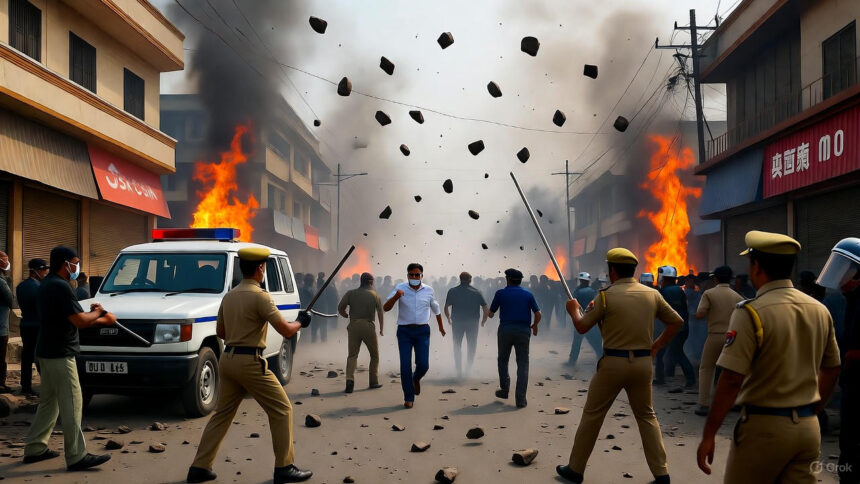
In the heart of Odisha’s ancient city of Cuttack, where the air usually hums with the rhythmic beats of dhol drums and the scent of incense during Durga Puja, a wave of violence has cast a long, uneasy shadow. What began as a vibrant idol immersion procession on the night of October 3, 2025, spiraled into communal clashes that left dozens injured, shops ablaze, and an entire city under lockdown. By October 7, the streets of this historic hub—once celebrated for its syncretic culture blending Hindu and Muslim traditions—echoed with the sirens of police vehicles rather than festive chants. This outbreak of unrest, triggered by seemingly minor disputes, underscores the fragile fault lines of religious harmony in modern India.
The trouble ignited in the early hours of October 4, around 2 a.m., near Haathi Pokhari in the densely populated Dargah Bazaar area. The Jhanjirimangala Bhagabat Puja Committee’s procession, carrying the revered idol of Goddess Durga toward Debigada for immersion, was met with objections from local residents over the blaring volume of music. What started as a verbal altercation quickly escalated into chaos. Stones and glass bottles flew through the night, shattering the festive spirit and injuring several participants, including Cuttack’s Deputy Commissioner of Police, Rishikesh Khilari, who suffered a gash on his forehead from a hurled stone. Six people were hurt in the initial fray, forcing police to wade in with lathi charges to disperse the agitated crowd. The incident, though contained temporarily, sowed seeds of resentment that would soon bloom into widespread turmoil.
By Sunday, October 5, the simmering tensions boiled over once more. The Vishwa Hindu Parishad (VHP), a Hindu nationalist group, had organized a motorcycle rally to protest what they perceived as police inaction against attacks on Hindu processions. Despite authorities denying permission citing the volatile atmosphere, a group of activists proceeded, waving flags and chanting slogans near sensitive spots like Gourishankar Park. The defiance met swift resistance from law enforcement, who blocked the rally. Enraged, the crowd pelted stones at officers, leading to a brutal standoff. Police retaliated with tear gas, rubber bullets, and further lathi charges. The violence peaked as rioters set fire to eight to ten shops in the vicinity, flames licking the night sky as firefighters battled the blaze under a hail of projectiles. Among the 25 injured that day were eight police personnel, including senior officer Amarendra Panda, who was rushed to the ICU at SCB Medical College and Hospital with severe wounds.
The government’s response was immediate and iron-fisted. A 36-hour curfew clamped down on 13 police station jurisdictions from the evening of October 5 until 10 a.m. on October 7, confining residents to their homes and sealing entry points to the city. Only essential workers and medical patients were granted passage, with passenger buses halted at checkpoints to weed out potential agitators. To stem the tide of rumors— including false claims of deaths during the Friday clash—internet services across Cuttack Municipal Corporation, the Cuttack Development Authority, and surrounding regions were blacked out for 24 hours under the Indian Telegraph Act. Social media platforms like WhatsApp, Facebook, and X fell silent, a desperate bid to prevent misinformation from fueling further discord. Over 1,800 state police personnel, bolstered by 800 from Central Armed Police Forces and Odisha’s Swift Action Force, patrolled the streets in flag marches, their presence a stark reminder of the city’s divided pulse.
On Monday, October 6, the VHP escalated its call to action with a 12-hour bandh, demanding accountability for the perceived bias in handling the processions. The shutdown evoked a patchy response: government offices and schools limped along with skeletal staff, while markets and fuel stations stayed open amid sparse crowds. Public transport ground to a halt, stranding commuters and amplifying the sense of isolation. By evening, eight individuals linked to the Sunday attacks on police were in custody, with three FIRs filed and CCTV footage aiding ongoing raids. Odisha Police issued stern warnings against spreading fake news, vowing “strict action” against those stoking unrest. Commissioner S. Dev Datta Singh assured the public that “the situation is under control,” while ADG Sanjay Kumar emphasized prompt measures against vigilantes.
As dawn broke on October 7, Cuttack teetered on a knife’s edge. Shattered glass littered Dargah Bazaar’s lanes, vandalized vehicles bore the scars of fury, and pharmacies and hospitals operated as oases of normalcy in a sea of tension. Residents, weary from the ordeal, voiced a collective yearning for peace. “Cuttack is a city of brotherhood,” lamented local Chintu Singh. “We all want to live together here. Some people spoil this atmosphere—they attack the police, and it troubles everyone.” The Chief Minister appealed for restraint, echoing opposition leaders’ pleas for unity in a city long synonymous with interfaith amity.
This episode in Cuttack is more than a fleeting flare-up; it mirrors deeper anxieties in India’s diverse tapestry. Durga Puja, a festival of triumph over evil, ironically became a battleground for old grievances—noise complaints morphing into symbols of cultural encroachment. With 31 injuries tallied and the internet blackout extended into Tuesday, the path to reconciliation remains fraught. Yet, in the quiet resolve of its people and the vigilance of its guardians, there glimmers hope that harmony can reclaim these sacred streets. As the idols submerge in the Mahanadi River, may the waters wash away not just clay, but the bitterness too.