



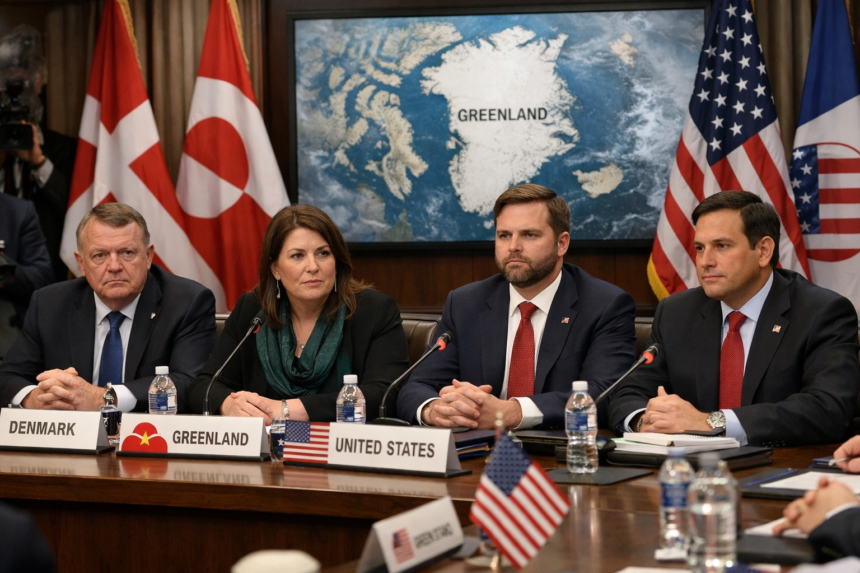
In a dramatic escalation of transatlantic diplomatic tensions, top officials from Denmark and Greenland met with U.S. Vice President J.D. Vance and Secretary of State Marco Rubio at the White House on Wednesday, January 14, 2026. The talks were convened to address U.S. President Donald Trump’s renewed insistence that the United States must take control of Greenland, a semi-autonomous territory within the Kingdom of Denmark — a proposal firmly rejected by both Danish and Greenlandic leaders.
President Trump has intensified his public campaign arguing that Greenland’s strategic Arctic position and natural resources make U.S. control essential to national security. In a statement shortly before the meeting, Trump wrote that the island’s inclusion in the American sphere would make NATO “far more formidable and effective” and described anything less than U.S. control as “unacceptable.”
Trump’s rhetoric has referenced concerns about rival powers such as Russia and China potentially gaining influence in the Arctic, underscoring his repeated warning that the U.S. must secure the territory to maintain global strategic advantage.
Both Danish Foreign Minister Lars Løkke Rasmussen and Greenland’s Foreign Minister Vivian Motzfeldt arrived in Washington determined to defend the sovereignty and territorial integrity of Greenland. Ahead of the talks, Greenland’s Prime Minister Jens-Frederik Nielsen reiterated that the island’s people identify with Denmark and NATO, firmly rejecting any notion of transferring control to the United States.
The message from Nuuk has been clear: Greenland is not for sale, and foreign attempts to pressure its governance are unwelcome. Nielsen emphasized that if forced to choose between the U.S. and Denmark, Greenland “chooses Denmark, NATO, and the EU.”
The unfolding situation is not just a bilateral issue between Washington and Copenhagen — it has reverberated across NATO and the European Union. Several European leaders, including EU Commission President Ursula von der Leyen, have publicly backed Denmark and Greenland, affirming that decisions about Greenland’s future must be made by its people and their elected representatives.
Some analysts warn that U.S. pressure to acquire Greenland — especially with talk of potential military leverage — could strain the alliance at a critical moment when Western unity is essential to deter geopolitical rivals. Any perception of U.S. aggression toward a NATO ally’s territory runs the risk of undermining collective defense principles that have sustained the alliance since World War II.
American public support for taking control of Greenland remains limited. Recent polls indicate a broad reluctance among U.S. citizens to pursue annexation, particularly by force. Many Americans view Trump’s bold strategy with skepticism, and most Greenlanders strongly oppose becoming a U.S. territory.
In Greenland itself, residents and community leaders have voiced support for the island’s continued partnership with Denmark rather than transferring allegiance to Washington. Concerns about cultural identity, democratic governance, and economic reliance on Danish support have all factored into the strong preference for maintaining the current political arrangement.
To address broader defense concerns in the Arctic, Denmark has announced plans to enhance its military presence in and around Greenland in cooperation with NATO allies. This includes joint training exercises and increased operational readiness to bolster regional security without compromising sovereignty. Sweden, for instance, confirmed support by contributing military personnel under Denmark’s “Operation Arctic Endurance.”
These moves reflect a shared understanding among European allies that a coordinated defense strategy is vital in the face of evolving geopolitical challenges, particularly as climate change opens new maritime routes and strategic interests in the High North grow.
As Wednesday’s meeting concluded, diplomats characterized the discussions as earnest but far from a breakthrough. Both sides reiterated their core positions: the United States seeks influence and security cooperation, while Denmark and Greenland insist on sovereignty and self-determination.
The talks were clearly aimed at de-escalating rhetoric and finding a diplomatic path forward but highlighted the deeply entrenched positions that make compromise difficult. Further negotiations are expected, possibly involving additional NATO and EU forums, as leaders seek to balance security, alliance unity, and respect for international law.
The diplomatic tug-of-war over Greenland could shape Arctic policy and transatlantic relations for years to come. As climate change accelerates geopolitical competition in the region, Greenland’s strategic importance is unlikely to diminish. The world watches closely as Washington and Copenhagen navigate this unprecedented diplomatic challenge — one that could redefine alliances and territorial norms in the 21st century.