


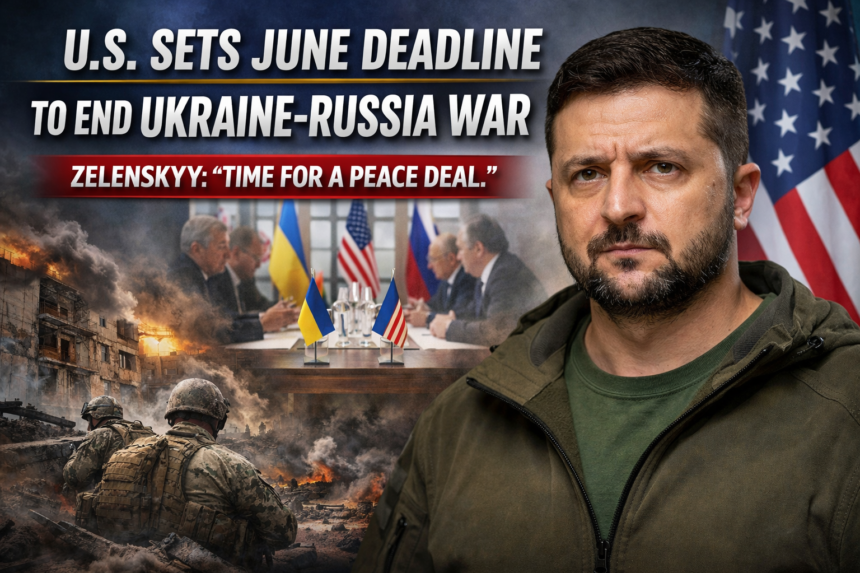
In a significant diplomatic development, Ukrainian President Volodymyr Zelenskyy has revealed that the United States has set a June deadline for Ukraine and Russia to reach an agreement to end the ongoing war. The announcement marks one of the strongest signals yet of intensified international pressure to bring the devastating conflict to a close.
Growing Global Pressure for Peace
Speaking to media representatives on Friday, Zelenskyy confirmed that Washington is actively pushing both Kyiv and Moscow toward a negotiated settlement. According to him, the United States has urged that the war, which has now stretched well beyond two years, should come to an end by June 2026.
The Ukrainian leader stated that while his country remains committed to defending its sovereignty and territorial integrity, it is also open to serious peace negotiations—provided they are fair and do not compromise Ukraine’s national interests.
“This war cannot continue indefinitely,” Zelenskyy said. “Our partners, especially the United States, are making it clear that diplomacy must prevail. A timeline has been proposed, and we are prepared to work within it if the conditions are just.”
US Mediation Efforts Intensify
The Biden administration has played a crucial role since the start of the Russia-Ukraine war, providing Ukraine with billions of dollars in military, financial, and humanitarian assistance. However, recent geopolitical developments and domestic political pressures in the US appear to have increased the urgency for a diplomatic resolution.
According to sources close to the discussions, American officials believe that a prolonged war would only deepen global economic instability and prolong human suffering. Setting a firm deadline is seen as a way to bring both sides to the negotiating table with renewed seriousness.
Diplomatic analysts say the June deadline reflects Washington’s desire to achieve a breakthrough before the US election season fully dominates the political landscape later this year.
Ukraine’s Position: Peace Without Surrender
Despite welcoming diplomatic efforts, Zelenskyy reiterated that Ukraine will not accept any deal that amounts to surrender. He emphasized that any peace agreement must respect Ukraine’s internationally recognized borders and ensure long-term security guarantees.
“Our goal is peace, but peace cannot be built on occupation or injustice,” Zelenskyy declared. “Ukraine has paid a heavy price in this war. Any settlement must reflect that reality.”
Ukraine has consistently demanded the full withdrawal of Russian troops from occupied territories, including Crimea and parts of eastern Ukraine. Moscow, however, has so far shown little willingness to concede these regions, making negotiations highly complex.
Russia’s Response Remains Uncertain
So far, the Kremlin has not officially commented on the reported June deadline. Russia has repeatedly stated that it is open to peace talks, but only under conditions that recognize what it calls “new territorial realities.”
Political observers believe that Moscow may use the US-imposed timeline as leverage, either to harden its demands or to seek concessions from both Ukraine and Western allies.
The coming months are expected to be crucial as international mediators attempt to bridge the massive gap between the two sides.
What a Potential Peace Deal Could Look Like
Experts suggest that any realistic peace agreement would likely involve several key components, including:
A ceasefire monitored by international observers
Security guarantees for Ukraine from Western nations
Gradual lifting of sanctions on Russia
Reconstruction funding for war-torn Ukrainian regions
Negotiations over disputed territories
However, reaching consensus on these issues remains a daunting challenge.
Humanitarian and Economic Impact
The war in Ukraine has caused one of the largest humanitarian crises in recent history. Millions of Ukrainians have been displaced, thousands have lost their lives, and entire cities have been reduced to rubble.
Beyond Ukraine, the conflict has disrupted global supply chains, contributed to rising energy prices, and affected food security in many parts of the world.
A successful peace deal would not only end the bloodshed but also help stabilize global markets and allow Ukraine to begin the long process of rebuilding.
International Community Watches Closely
Nations across Europe and beyond are watching the latest developments with cautious optimism. Many leaders have welcomed the idea of a clear diplomatic timeline, though some remain skeptical about whether Russia will genuinely engage in meaningful negotiations.
NATO allies continue to support Ukraine militarily while also expressing hope that a just and lasting peace can be achieved through dialogue.
The Road Ahead
With the June deadline now publicly acknowledged, the next few months are likely to witness intense diplomatic activity. High-level meetings, backchannel negotiations, and international summits are expected as mediators attempt to craft a workable solution.
While challenges remain immense, Zelenskyy’s statement has injected new momentum into global peace efforts. Whether this timeline will ultimately bring an end to Europe’s deadliest conflict since World War II remains to be seen.