



- 0Shares
- 20 Views
The 2026 West Bengal Assembly election, held in West Bengal, turned out to be one of the most talked-about political events in recent years. It marked a major shift in the state’s political direction, especially if we imagine a scenario where the Bharatiya Janata Party (BJP) wins and forms the government. For decades, West Bengal politics has been dominated first by Left parties and later by the Trinamool Congress (TMC), led by Mamata Banerjee. A BJP victory in 2026 would therefore represent a dramatic political change.
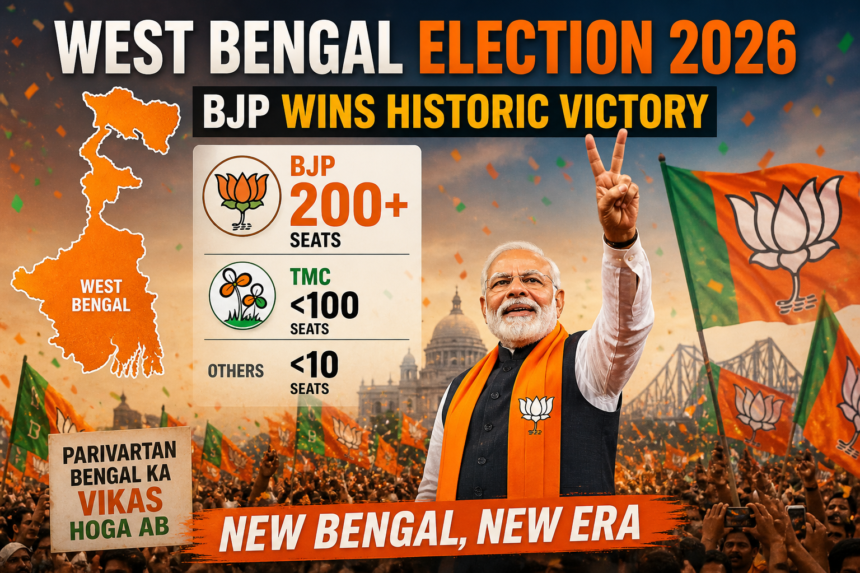
The West Bengal Legislative Assembly consists of 294 seats, and to form a government, a party or alliance needs at least 148 seats. In this scenario, the BJP manages to cross that mark comfortably, winning around 190 to 210 seats. This gives the party a clear majority and allows it to form the government without relying on coalition partners. Such a result would not only be historic but would also signal a strong shift in voter preferences across the state.
One of the main reasons behind BJP’s success could be its long-term preparation and expansion strategy in West Bengal. Over the years, the party has worked on strengthening its grassroots presence. From booth-level workers to district leadership, BJP focused on building a strong organizational network. This helped the party connect directly with voters, understand local issues, and respond effectively during the campaign.
Another important factor would be anti-incumbency against the ruling TMC government. After being in power for many years, any government tends to face public dissatisfaction. Issues such as unemployment, corruption allegations, and concerns over governance may have influenced voters to look for an alternative. BJP positioned itself as that alternative, promising change, better administration, and development.
Leadership also played a crucial role in this imagined victory. National leaders like Narendra Modi campaigned actively in the state, addressing large rallies and presenting a vision of growth and progress. The party’s campaign strategy combined strong messaging with extensive outreach, both online and offline. Social media, digital campaigns, and local engagement programs helped BJP reach young voters and first-time voters effectively.
The shift in voter demographics could also explain BJP’s success. In recent years, young voters have become more influential in elections. Many of them prioritize employment opportunities, infrastructure, and economic development. BJP’s focus on these areas likely resonated with this group. Additionally, the party may have gained support from sections of rural voters who were seeking better facilities and improved living conditions.
Another contributing factor would be the weakened position of other opposition parties such as Congress and Left Front. In earlier elections, these parties had a strong presence in West Bengal, but over time their influence has declined. This created a direct contest mainly between BJP and TMC. As a result, anti-TMC votes may have consolidated in favor of BJP, giving it an advantage in many constituencies.
The election campaign itself would have been intense and highly competitive. Rallies, roadshows, and public meetings would dominate the political atmosphere across cities like Kolkata as well as rural areas. Both BJP and TMC would try to highlight their achievements and criticize each other’s policies. Voters, on the other hand, would carefully evaluate their options before making a decision.
If BJP indeed wins around 200 seats, it would not just be a victory—it would be a landslide. Such a mandate would give the party the power to implement its policies more effectively and shape the future of the state. It would also have a strong impact on national politics, as West Bengal is one of India’s most important states in terms of population and political influence.
In conclusion, a BJP victory in the 2026 West Bengal election, with around 190–210 seats, would reflect a combination of strong organization, effective leadership, voter dissatisfaction with the current government, and changing political preferences. It would mark the beginning of a new political chapter in West Bengal, highlighting how dynamic and unpredictable democracy can be in India.