


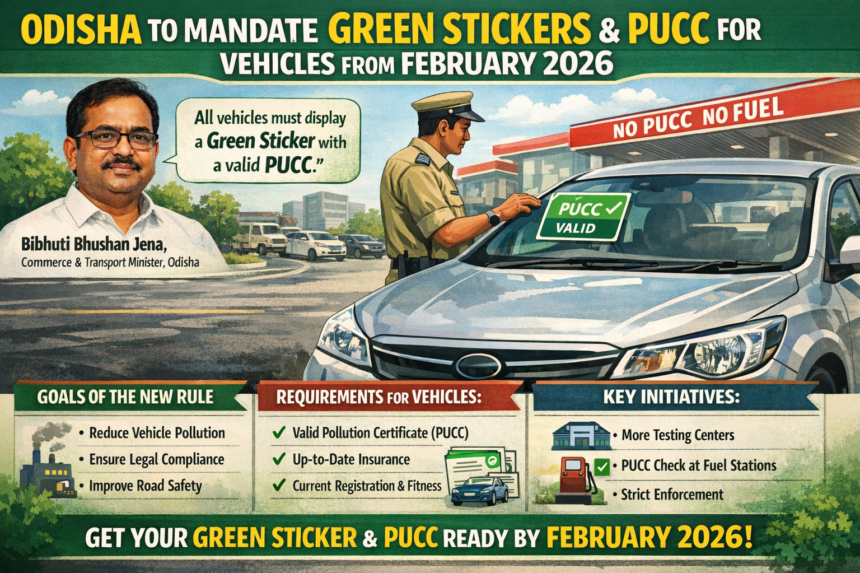
The Government of Odisha has recently announced a major regulatory change aimed at tightening road safety and environmental controls: starting February 2026, all motor vehicles in the state will be required to carry a mandatory green sticker indicating valid compliance with key statutory requirements, including the Pollution Under Control Certificate (PUCC). This landmark decision, unveiled by Commerce and Transport Minister Bibhuti Bhushan Jena, marks a significant shift in how vehicle compliance will be monitored and enforced across the state.
The central aim of this initiative is to ensure that vehicles plying on Odisha’s roads fully comply with the provisions of the Motor Vehicles Act, 1988, particularly those related to pollution, insurance, registration, and fitness certifications. While many of these requirements have been part of the law for years, the new rule makes visible evidence of compliance — through a green sticker — a mandatory requirement for all vehicles. The move reflects growing concern over vehicular emissions and the urgent need to protect public health by reducing air pollution in urban and rural areas alike.
What the Green Sticker Represents
The green sticker will serve as an official certification issued by the Transport Department indicating that a vehicle has:
-
A valid Pollution Under Control Certificate (PUCC)
-
Up-to-date insurance
-
Current registration
-
A valid fitness certificate where applicable (e.g., for commercial vehicles)
Officials have clarified that the sticker is not intended to generate revenue or penalize the public unnecessarily, but rather to visibly showcase compliance with motor vehicle regulations. From February 2026, authorities will take action against vehicles observed without the requisite sticker, indicating non-compliance.
Why This Change Was Introduced
Several reasons underlie Odisha’s decision to adopt the green sticker norm:
-
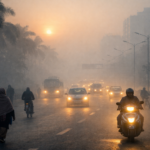
Curbing Vehicular Pollution: Roads across Indian cities, especially fast-growing ones like Bhubaneswar and Cuttack, face worsening air quality. Ensuring that vehicles meet emission standards is a direct method to reduce pollution. The green sticker makes it easier for enforcement officers to spot vehicles that comply and those that do not.
-
Improving Compliance with Existing Laws: Although pollution certificates and other documents have long been legally required, enforcement has been uneven. A visible compliance mark on vehicles is expected to improve adherence to the law.
-
Addressing Systemic Issues in Pollution Certification: Transport officials have raised serious concerns over how some PUCCs are being issued. There have been instances where pollution certificates were granted without proper testing, undermining the purpose of such certification. The government plans to review the system of issuing PUCCs and expand testing centres as needed to ensure accountability and reduce bottlenecks.
-
Facilitating Enforcement at Fuel Stations: To further strengthen pollution compliance, the State Transport Authority (STA) earlier directed oil marketing companies not to dispense petrol or diesel to vehicles without a valid PUCC. Implementation of this “No PUCC, No Fuel” policy has been postponed until February 2026 as well, giving vehicle owners additional time to comply.
Timeline and Implementation
The green sticker requirement will take effect from February 11, 2026, giving vehicle owners a small window to prepare, update their documents, and obtain the sticker. Authorities have been instructed to undertake awareness campaigns ahead of the deadline so the public is informed well in advance.
Simultaneously, the PUCC enforcement as a prerequisite for dispensing fuel will also start around February, after an earlier plan to begin in January was deferred to give motorists more time to renew documents.
To support this, the state government is also cracking down on fraud in pollution testing: the licenses of dozens of fake pollution testing centres were recently cancelled after investigations revealed malpractice in issuing invalid certificates. This decisive action aims to ensure that PUCC certifications are legitimate and traceable.
What Vehicle Owners Need to Do
For all vehicle owners in Odisha, the steps to comply and avoid penalties are straightforward:
-
Check Pollutant Emissions: Renew or obtain a valid PUCC at an authorized testing centre well before February 2026.
-
Ensure Legal Documents Are Up to Date: This includes valid registration, insurance, and fitness certificates where applicable.
-
Obtain the Green Sticker: Visit the Transport Department or follow the official process to get your vehicle’s green sticker issued before the deadline.
-
Be aware that once the rules are in force, vehicles found without the sticker — or without valid PUCC — may face penalties and enforcement actions.
Broader Impacts and Public Response
The government has stressed that this initiative is for public good — protecting health, reducing emissions, and making enforcement simpler and more transparent. While some vehicle owners may view it as an additional compliance burden, the state believes the long-term benefits will outweigh the short-term adjustments.
Public awareness campaigns and steps to improve access to testing centres should help ease the transition. Overall, Odisha’s approach could serve as a model for other states looking to combine environmental regulation with visible compliance mechanisms.